USS Johnston Poster
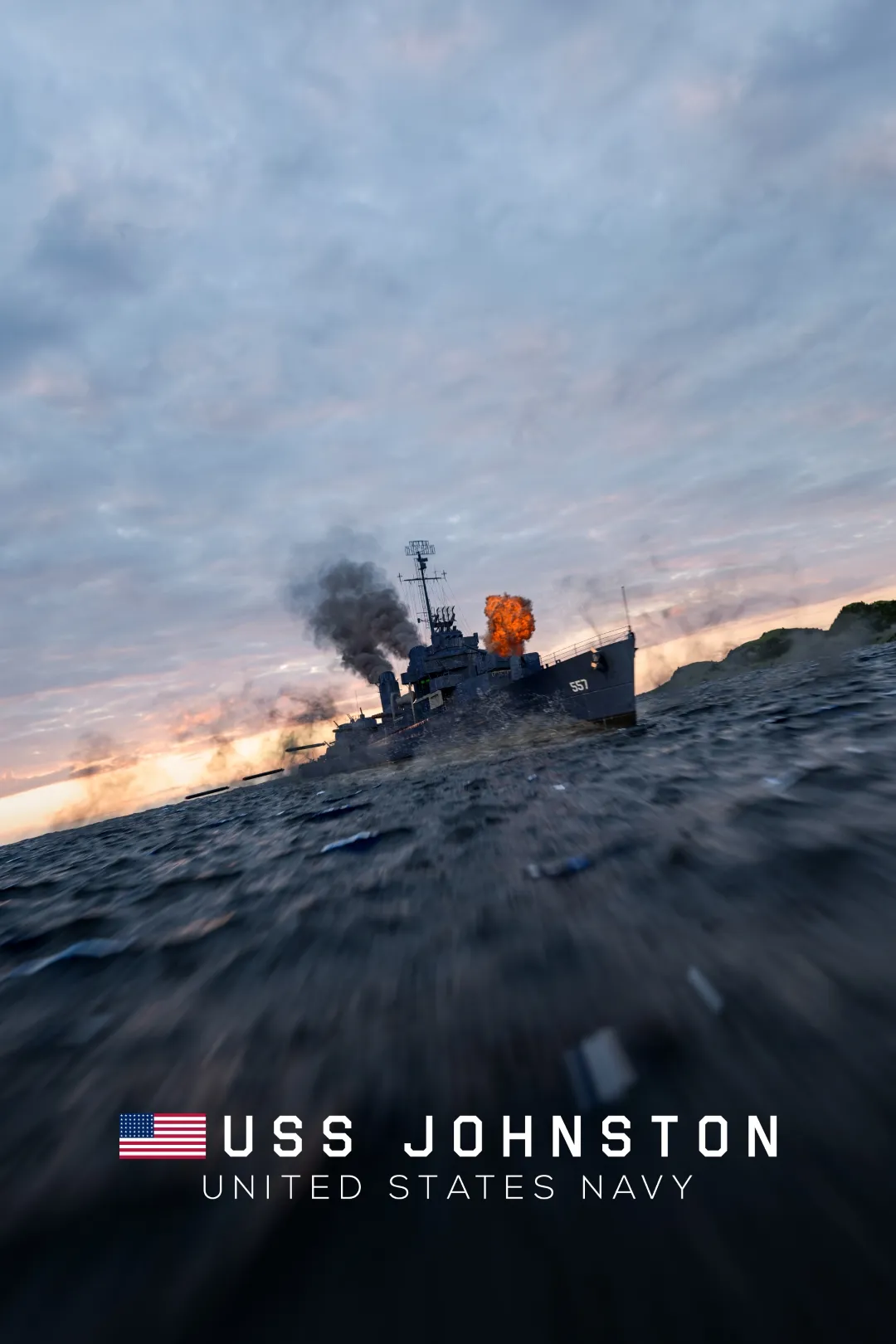
She was a single destroyer who took on the most powerful battleship fleet afloat — and her commander earned the Medal of Honor for one of the most heroic actions in the history of naval warfare. USS Johnston was a Fletcher-class destroyer, and her last fight off the island of Samar in October 1944 has become legend, the very symbol of courage against impossible odds. At the Battle of Leyte Gulf, a massive Japanese force of battleships and heavy cruisers — led by the giant Yamato, the largest battleship ever built — surprised and ambushed the tiny American escort group "Taffy 3," a handful of small, slow escort carriers and their thin-skinned destroyers and destroyer escorts. By every measure the Americans should have been annihilated within the hour. Instead, they turned and charged. Johnston's captain, Commander Ernest E. Evans — a man of Cherokee and Creek heritage who had told his crew on the day she was commissioned that he intended to go in harm's way and would never run from a fight — did not wait for orders. He swung his lone destroyer toward the oncoming Japanese fleet and attacked. Through a hurricane of shellfire Johnston closed the range, fired her full spread of torpedoes, and blew the bow off a Japanese heavy cruiser. Her 5-inch guns blazed away at battleships and cruisers many times her size, scoring dozens of hits that, while they could not sink armoured giants, added to the confusion and fury of the American assault. The enemy struck back savagely. Heavy shells smashed into Johnston, knocking out an engine, guns and steering, wounding Evans — who lost fingers and was bleeding badly — and killing many of her crew. Still she fought on. The wounded captain conned his crippled ship from the after steering position, shouting orders down to men turning the rudder by hand, fighting the destroyer with whatever still worked. For more than two hours the little ship dueled the Japanese fleet, charging again and again, drawing fire away from the vulnerable carriers. At last, surrounded, shattered and dead in the water, Johnston went down, ringed by enemy ships. Commander Evans went into the water with his crew but was never seen again. A Japanese officer aboard one of the destroyers that finished her, watching the American ship sink, is said to have saluted her courage as she went under. Johnston's sacrifice, with that of the other ships of Taffy 3, helped convince the Japanese commander to break off and retire, saving the escort carriers and the vast, vulnerable invasion fleet beyond them. Her wreck was located in 2021 at a depth of around 6,450 metres — the deepest shipwreck ever surveyed, a fitting and almost unreachable resting place for an immortal ship. To reconstruct USS Johnston is to capture that legendary charge off Samar — a single destroyer attacking a fleet of battleships and refusing to stop. She is the ultimate emblem of valour against hopeless odds, and her captain's words, "we will go into harm's way," became the truth of her final hour.