French Destroyer L'Audacieux Poster
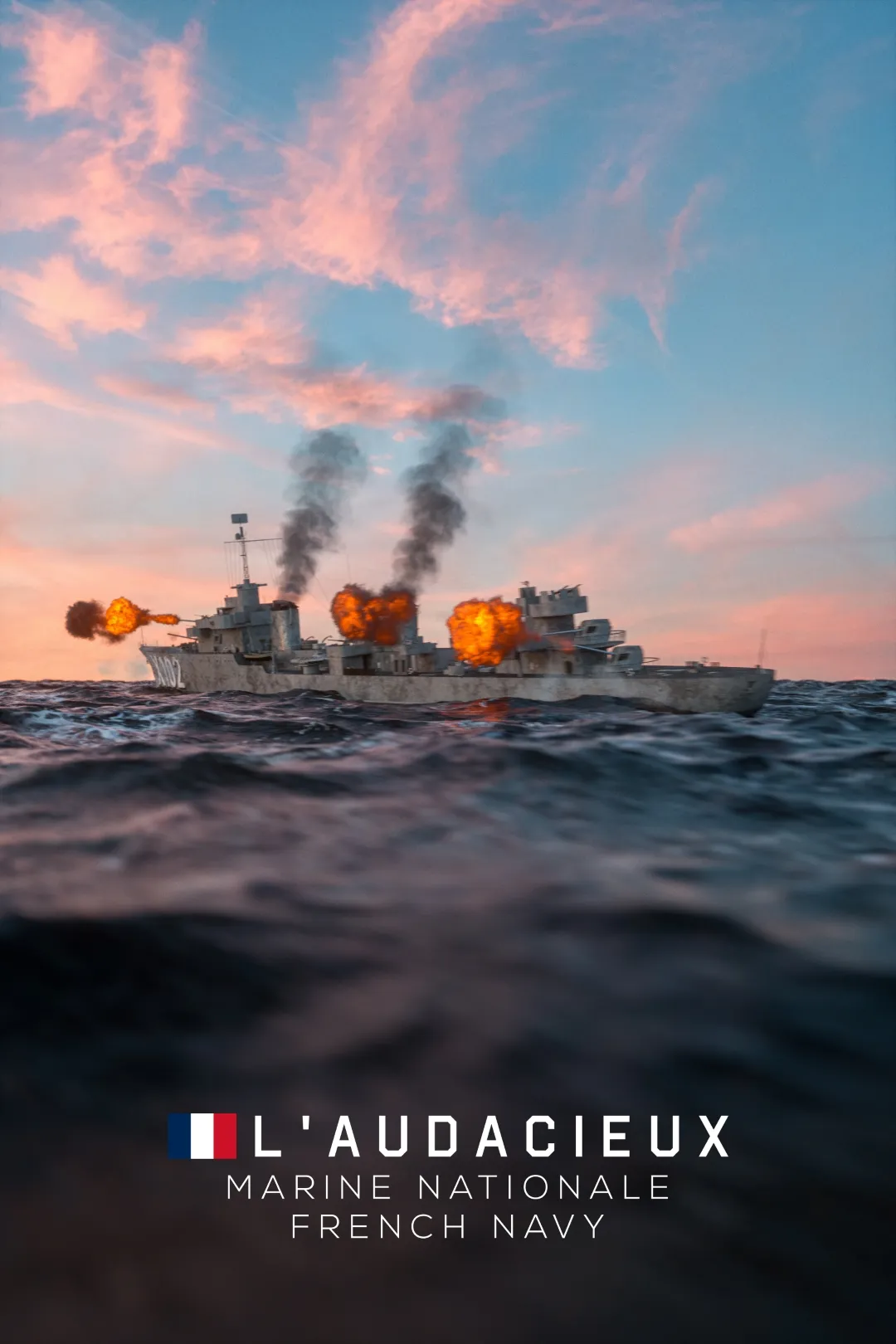
Her name meant "The Audacious," and few ships earned a name so completely. L'Audacieux was a Le Fantasque-class large destroyer — a contre-torpilleur, in the French term — and these were among the fastest warships ever built. Long, lean and powerful, they were designed to do something most navies thought impossible: to outrun anything they could not outshoot, and outshoot anything fast enough to catch them. On trials, ships of her class tore across the water at well over 40 knots, with some runs exceeding 45, speeds that still astonish naval historians. Armed with five 138 mm guns and banks of torpedoes, L'Audacieux was a greyhound with teeth. When war came in September 1939, the Le Fantasques were assigned to the Force de Raid, hunting German commerce raiders and blockade runners across the Atlantic approaches. L'Audacieux patrolled the central Atlantic from Dakar, then returned to home waters and the Mediterranean as Italy's intentions darkened. It was fast, glamorous work — the kind of service these ships were born for. Then, in the summer of 1940, France collapsed, and like so much of the fleet, L'Audacieux found herself flying the flag of Vichy, loyal to a government that had signed an armistice with the enemy. Her defining hour came at Dakar in September 1940. As a British and Free French force arrived in Operation Menace, trying to win the colony over to General de Gaulle or take it by force, L'Audacieux was ordered out on a reconnaissance sweep. It was a brave and reckless gesture, and it ended in disaster. She ran headlong into Allied cruisers at close range, and a salvo of heavy shells smashed into the slender destroyer, knocking out her power and setting her ablaze from end to end. Burning fiercely, drifting and helpless, she was run onto the shore to save what was left of her crew. It was the cruel arithmetic of that strange, bitter campaign — French sailors dying under fire from the very allies they had fought beside a year before. But L'Audacieux refused to die easily. Salvaged from the beach and patched back together, she was eventually returned to service — only to meet her true end in 1943 at Bizerte in Tunisia, destroyed in Allied air raids as the Axis position in North Africa crumbled into ruin. Twice, in effect, the war claimed her: once at the hands of Britain, once in the wreckage of the Axis collapse. Her story is one of speed, defiance, and the tragedy of a navy caught on the wrong side of history through no fault of its sailors. She was a thoroughbred built for bold action, and when the moment came she charged — into a fight she could not win, against ships she should never have faced, doing it anyway. That was the audacity written into her name, and the spirit that made her, however briefly, one of the boldest little ships ever to fly the French ensign. To reconstruct her is to honour both her astonishing design and the courage of the men who took her into an impossible battle.