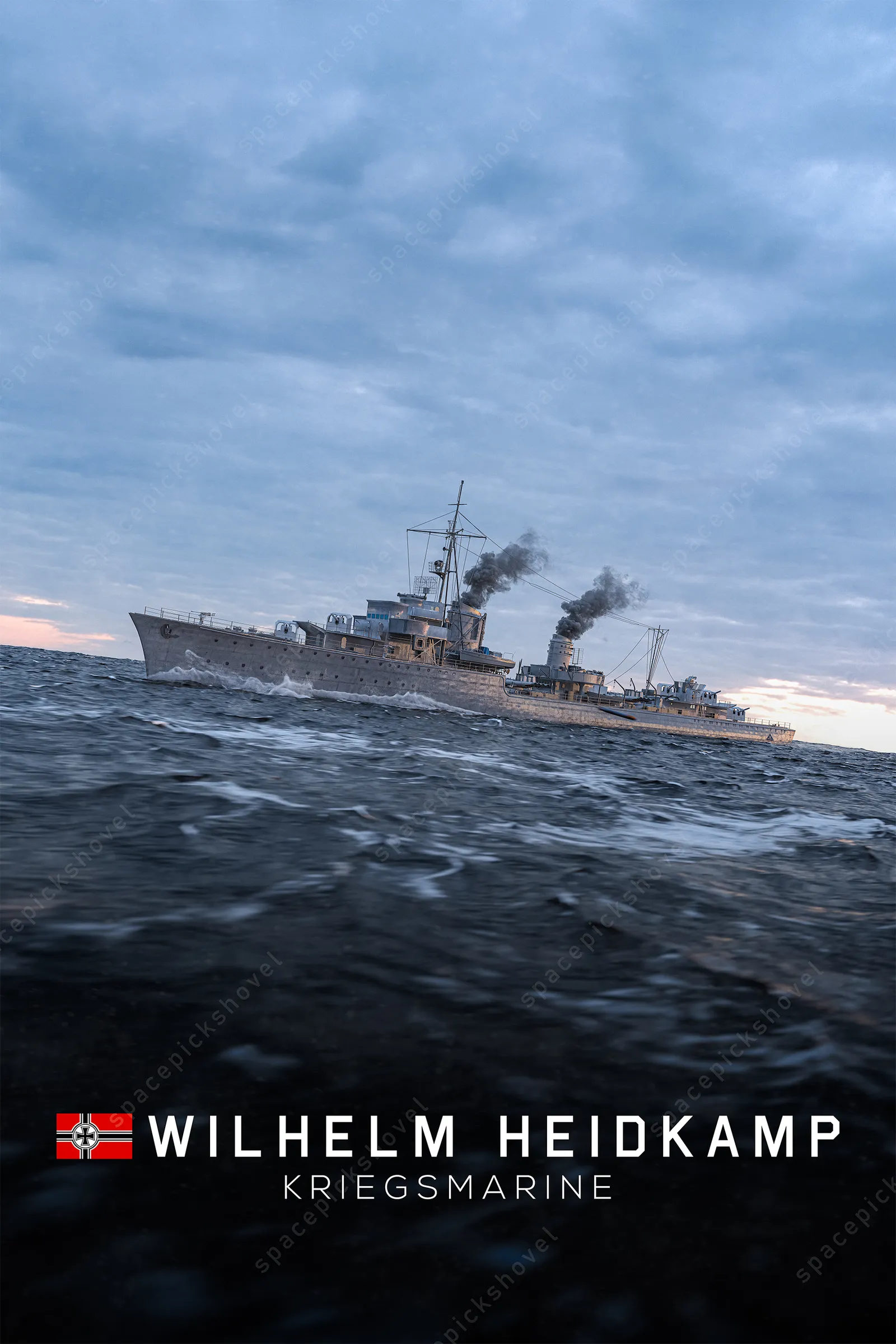
German Destroyer Wilhelm Heidkamp Poster
She was a flagship, and she died like one — early, violently, and at the very heart of the storm. Z21 Wilhelm Heidkamp was a large German destroyer of the Type 1936 class, fast and heavily armed for her size, and she was chosen to lead one of the boldest gambles of the 1940 Norwegian campaign: the seizure of the iron-ore port of Narvik, deep inside a long fjord far up the Norwegian coast, almost within the Arctic Circle. In April 1940, as Operation Weserübung opened, Wilhelm Heidkamp spearheaded the assault as flagship of the Narvik group, carrying Commodore Friedrich Bonte and the headquarters staff and packed with mountain troops. Slipping through the fjords in foul weather, the German destroyers achieved complete surprise. When the old Norwegian coastal defence ship Eidsvold blocked the way and refused to surrender, Wilhelm Heidkamp loosed her torpedoes and blew the elderly warship apart in an instant. Narvik fell to the Germans almost without a fight, and the destroyers crowded into the narrow harbour to land their troops and refuel from a captured tanker, believing the worst was behind them. It was not. At dawn on 10 April, out of the snow and mist at the head of the fjord, five British destroyers of the 2nd Destroyer Flotilla swept in to attack — a daring surprise raid that became the First Battle of Narvik. In the chaos that followed, a torpedo from the British leader HMS Hardy found Wilhelm Heidkamp and struck her squarely in the stern, detonating her aft magazine. The explosion was catastrophic. It hurled her rear gun turrets into the air and killed Commodore Bonte and around 80 of her men in a single shattering moment, decapitating the German command at the very start of the battle. Mortally wounded, her stern blown open and sinking, the flagship clung to life for one more day before capsizing — but not before her surviving torpedoes were salvaged and transferred to the other German destroyers still in the fight. She had led the attack that took Narvik, and now she paid the price for it, the first of the German ships to fall in what would become a graveyard for the entire flotilla. In the two battles of Narvik that followed, the Royal Navy would destroy all ten German destroyers trapped in the fjords, a blow from which the Kriegsmarine's destroyer arm never fully recovered. Wilhelm Heidkamp's story is the story of that campaign in miniature: surprise and triumph turning to disaster in a matter of hours, far from home, in some of the most forbidding waters on earth. She lies still in those northern depths, the leader who went down at the front of the line, taking her admiral with her. To reconstruct her is to recover a ship most people have never heard of but whose violent end shaped the whole Norwegian campaign — the flagship that struck the first blow at Narvik and was the first to be struck down in return.