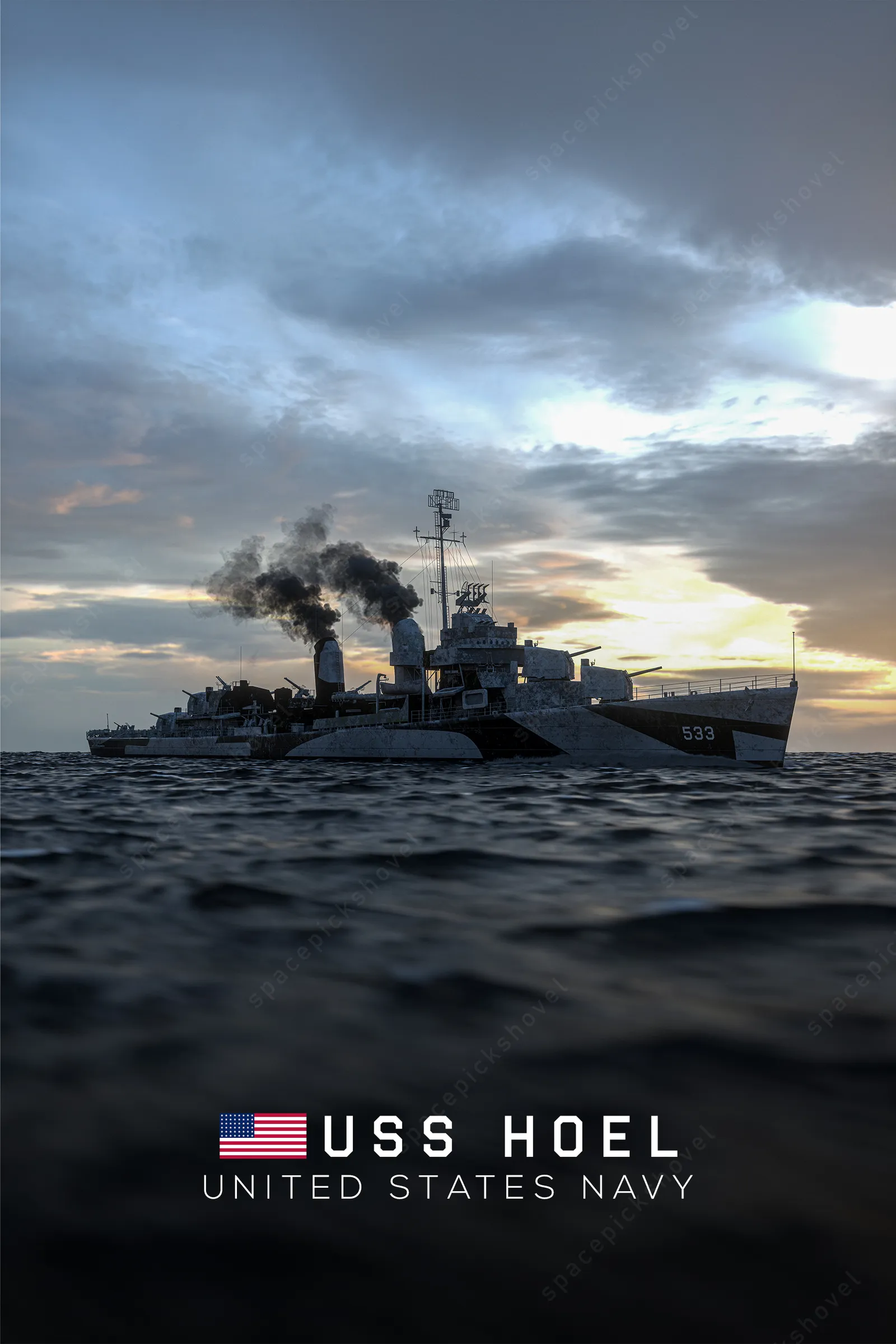
USS Hoel Poster
She was a destroyer that charged a fleet of battleships and cruisers head-on — and her near-suicidal courage helped save an American invasion. USS Hoel was a Fletcher-class destroyer, part of the tiny escort group known as "Taffy 3," and her last battle off the island of Samar in October 1944 stands as one of the most heroic actions in the entire history of the United States Navy. At the Battle of Leyte Gulf, a powerful Japanese fleet — including the colossal battleship Yamato, the largest ever built, along with other battleships, heavy cruisers and destroyers — slipped through undetected and fell upon a thin screen of small American escort carriers and their handful of equally small escorts. The Americans were hopelessly outmatched; the Japanese heavy guns alone could have annihilated the entire group at long range. The only hope of saving the carriers and the troops on the invasion beaches behind them was to charge — to throw the destroyers and destroyer escorts straight at the oncoming enemy battle line, to throw the Japanese attack into confusion and buy precious time. Hoel led the charge. Tiny and almost defenceless against the armoured giants bearing down on her, she raced in through a storm of shellfire, launched her torpedoes at the enemy battle line, and pressed her attack home with reckless, magnificent audacity — forcing mighty Japanese battleships and cruisers to turn and comb the tracks of her torpedoes, throwing off their aim and their advance. Her 5-inch guns, almost useless against heavy armour, blazed away in defiance as she dueled ships many times her size. The enemy's fire found her, as it had to. Shell after shell smashed into Hoel — by some accounts more than forty hits — knocking out her engines and her guns one by one, until she lay dead in the water, riddled, broken and sinking. Her surviving crew kept firing to the very end, working the guns that still functioned as the ship died around them. At last she rolled over and went down, taking most of her men with her into the sea. But the sacrifice worked. The ferocity of Taffy 3's charge — Hoel, Johnston, Samuel B. Roberts and the others, hurling themselves at a vastly superior fleet — convinced the Japanese commander that he faced a far stronger force than he did, and, shaken and disorganised, he broke off the attack and turned back. The escort carriers and the invasion they covered were saved. Hoel had died, but in dying she had helped win one of the most improbable victories of the war. To reconstruct USS Hoel is to capture that desperate, glorious charge off Samar — a little Fletcher-class destroyer flinging herself at battleships to save the ships and men behind her. She is the embodiment of a particular kind of courage: not the courage of the strong, but of the hopelessly outgunned who attack anyway, and whose sacrifice turns certain disaster into legend.