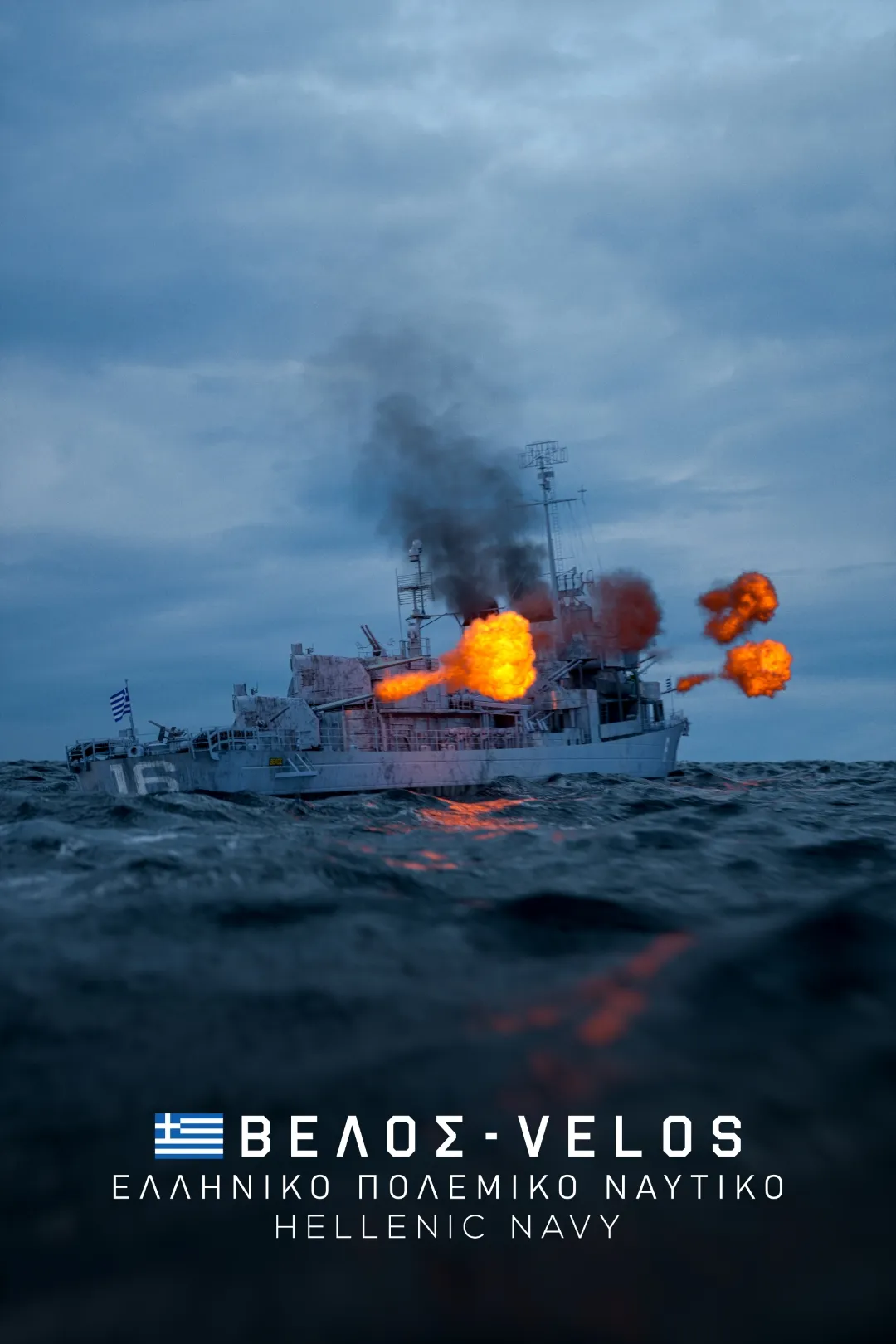
Hellenic Navy Destroyer Velos Poster
Most warships earn their fame in battle. The Greek destroyer Velos earned hers by refusing to obey. Her hull began life far from the Aegean, as the American USS Charrette, a Fletcher-class destroyer that fought across the Pacific in the Second World War. In 1959 she was transferred to Greece and renamed Velos — "Arrow" — and for over a decade she was simply a faithful, hard-working unit of the Hellenic Navy, indistinguishable from any other Cold War destroyer. Then came 1973, and a single act that turned her into a national symbol of freedom. By the early 1970s Greece was ruled by a brutal military junta — the dictatorship of the colonels — that had seized power in 1967 and crushed dissent with arrests, censorship and torture. Velos was at sea, taking part in a NATO exercise in the Mediterranean, when her commander, Nikolaos Pappas, heard over the radio that naval officers back home were being arrested and tortured for opposing the regime. Pappas belonged to a circle of officers loyal to their oath to the constitution rather than to the dictators, and in that moment he made an extraordinary choice. Rather than return his warship to a tyranny, he broke away from the NATO fleet and sailed Velos to the Italian port of Fiumicino, near Rome, and dropped anchor in open, deliberate defiance. There the captain, a group of officers and crew announced to the world's press that they would not serve the junta, and requested political asylum. It was not a mutiny against their country — it was a stand against those who had stolen it. The act sent a shock through Greece and around the world, a defiant signal that the spirit of resistance lived even within the armed forces the dictatorship believed it controlled. The crew who stayed in Italy became political exiles; Velos herself was eventually returned to Greece with a replacement crew. But the gesture could not be undone, and history soon vindicated it. The junta collapsed the following year, and democracy returned to Greece. Commander Pappas, far from being disgraced, rose in the restored navy to become a vice admiral and chief of the Hellenic Navy General Staff — the rebel honoured by the country he had refused to betray. Today Velos is preserved not as a monument to the battles she fought in the Pacific, but as a "Museum of the Anti-Dictatorship Struggle," moored on the waterfront and open to visitors as a floating reminder of that moment of conscience. She is honoured for the enemies she would not serve rather than the enemies she destroyed — a warship remembered for an act of moral courage rather than firepower. To reconstruct Velos is to tell a story unlike any other in this fleet: not of guns and sinkings, but of the day a captain and crew decided that the greatest stand a warship can make is sometimes simply to drop anchor in a foreign port and say, to a regime that had betrayed everything they swore to defend: no further. Few ships carry a meaning like hers.