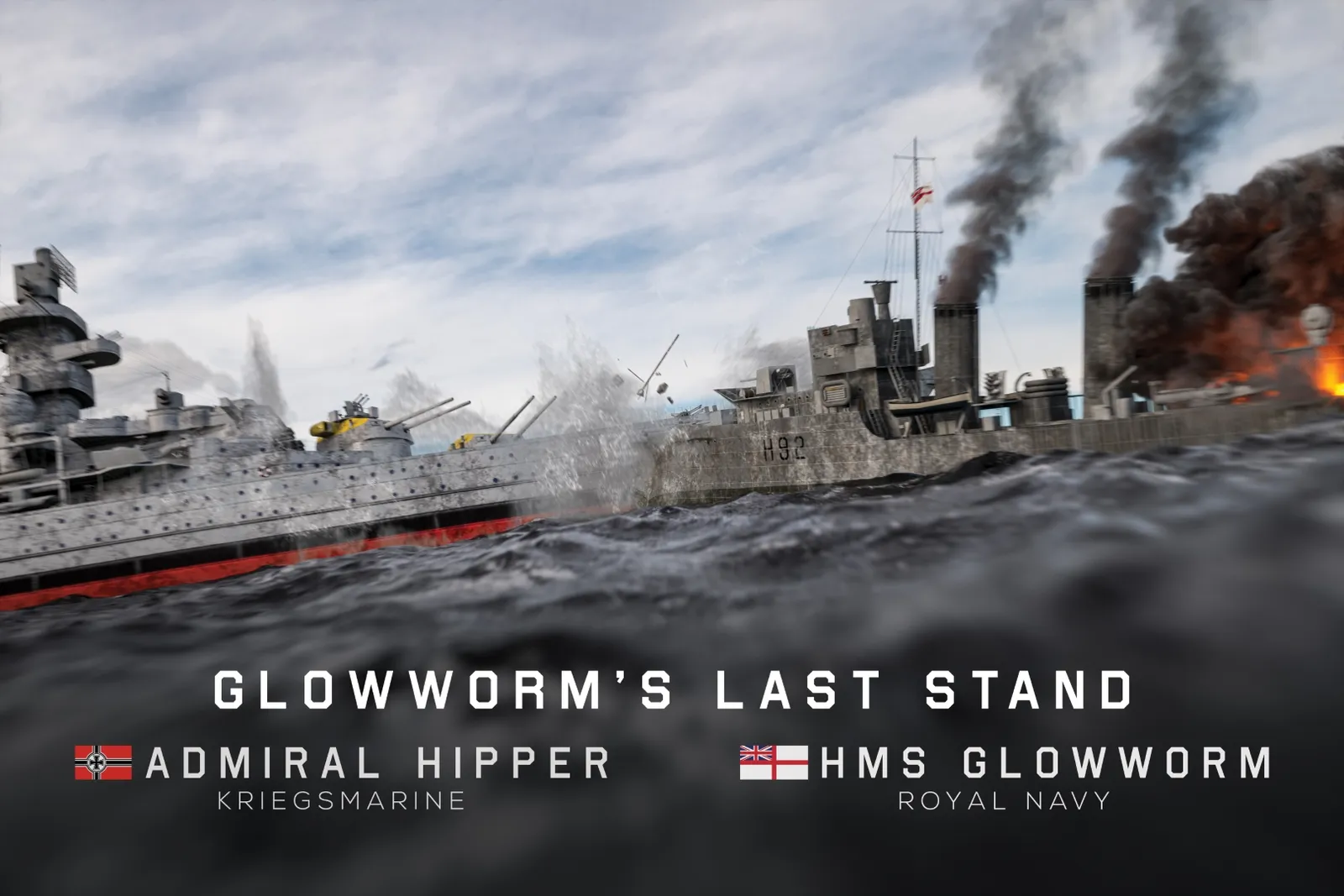
Glowworm's Last Stand Poster
Some ships are remembered for what they sank. HMS Glowworm is remembered for the impossible thing she did in the last minutes of her life. She was a small G-class destroyer of the Royal Navy, alone in heavy seas off the coast of Norway in early April 1940, when she stumbled into the path of the German invasion fleet — and into the gun range of the heavy cruiser Admiral Hipper, a ship many times her size and overwhelmingly more powerful. Glowworm had become separated from her squadron while searching for a man washed overboard in the storm. When she met the German screen, the encounter quickly escalated into a fight no destroyer could hope to win. Hipper's heavy 203 mm shells walked across the little ship, smashing her superstructure, knocking out guns, and starting fires that could not be controlled. Glowworm was already doomed — listing, burning, her commander Lieutenant Commander Gerard Roope fighting his dying ship as men fell around him in the smoke and spray. Roope made a decision that turned certain defeat into immortal legend. He laid a smoke screen, swung his shattered destroyer hard around, and drove her bow-first straight at the towering German cruiser. Through the smoke Glowworm rammed Admiral Hipper, tearing a great gash some forty metres long in the cruiser's armoured side and ripping away part of her torpedo armament and forward plating. For a moment the minnow had its teeth in the whale; the two ships ground together in a screech of rending steel before Glowworm scraped clear, blazing from end to end. Moments later her boilers exploded and she rolled over and sank beneath the grey waves. What happened next is what lifts the story beyond mere courage. The German captain, Hellmuth Heye, was so moved by the ferocity and bravery of the doomed destroyer that he stopped his cruiser amid the danger of enemy waters to pull survivors from the freezing sea — and later, through the International Red Cross, sent word to the British recommending Glowworm's captain for the highest award for valour. That recommendation, made by the very enemy who had killed him, helped earn Gerard Roope a posthumous Victoria Cross. It was the first VC of the Second World War to be awarded substantially on the testimony of an opponent — a rare and remarkable tribute from one fighting man to another across the lines of a brutal war. Only a handful of Glowworm's crew survived to become prisoners; the great majority went down with their ship. Her action achieved little in pure military terms — Admiral Hipper was repaired and fought on — yet it became one of the most stirring acts of defiance in the history of the Royal Navy. A tiny, broken destroyer, with no hope of victory and no chance of escape, chose to charge a cruiser rather than simply sink. To reconstruct Glowworm's last stand is to freeze that single, extraordinary moment in steel and fire: the instant the doomed destroyer turned and drove herself at an enemy four times her size. It is a portrait not of a famous, war-winning ship, but of something rarer — pure, deliberate courage in the face of certain death, honoured even by the men who dealt it.