The Story of IJN Kaga
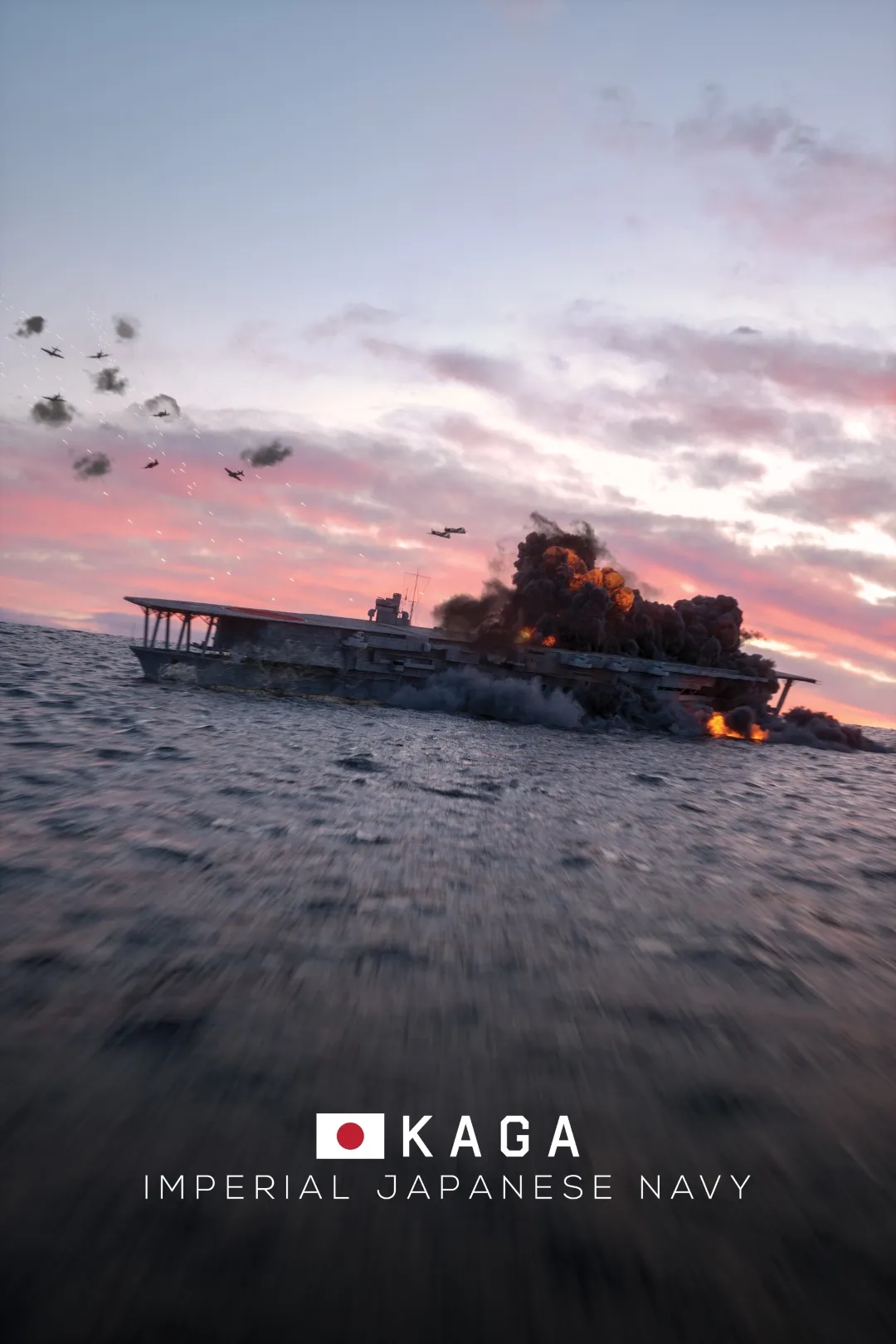
She was big, she was powerful, and she carried more aircraft than almost any carrier in the fleet — a floating airfield that helped Japan dominate the skies over the Pacific in the opening months of the war. IJN Kaga had begun life as a battleship hull, a product of the great naval treaties, before being converted into one of the largest aircraft carriers of her era. By 1941 she was a cornerstone of Vice Admiral Nagumo's feared Kido Butai, her enormous air group making her one of the heaviest hitters in a fleet that seemed unbeatable. Kaga's planes were among those that fell upon Pearl Harbor on the morning of 7 December 1941, her bombers and torpedo aircraft helping to wreck the American Pacific Fleet at its moorings in a single shattering blow. Through the early months of the war she ranged far and wide with the Kido Butai, her large complement of aircraft adding weight to every strike as Japan's carriers carried all before them across the Pacific. Her doom came at Midway, on the same catastrophic morning that consumed her sisters. On 4 June 1942, Kaga's decks were crowded with aircraft being fuelled and armed for a strike against the American fleet when the US dive bombers screamed down out of the sky. In the space of minutes several bombs slammed into her flight deck, punching through to the hangars below where aviation fuel and ordnance lay everywhere in the frantic rearming. One bomb burst near the bridge, killing the captain and almost the entire command staff in an instant. The explosions and fires that followed were apocalyptic. Kaga, the largest of the carriers lost that day, became a drifting furnace, her crew unable to contain the spreading inferno as fuel and bombs cooked off within her. Hundreds of men died in the flames and smoke. By evening she was a gutted, blazing hulk, and at last she slipped beneath the waves, claimed by the fires that had raged through her from within. Kaga was one of the four irreplaceable fleet carriers — with Akagi, Soryu and Hiryu — that Japan lost in that single, decisive battle, a blow that broke the back of the Imperial Navy's carrier force and turned the course of the Pacific War. Her wreck was discovered deep on the Pacific floor near Midway in 2019, one of the great finds of modern marine archaeology, lying silent more than 5,000 metres down. To reconstruct IJN Kaga is to capture one of the giants of the early Pacific — a converted battleship turned mighty carrier, her decks packed with the aircraft that struck Pearl Harbor — caught at the moment of her destruction, when the war's tide turned in a few minutes of fire and explosion. She helped open the war in triumph, and died at the hinge on which it swung.
Reconstruction Pipeline
Frequently Asked About IJN Kaga
What was the IJN Kaga?
A large Japanese aircraft carrier converted from a battleship hull, carrying one of the biggest air groups in the fleet; her planes struck Pearl Harbor.
How was the Kaga sunk?
Bombed by US dive bombers at Midway on 4 June 1942; multiple hits ignited fueled, armed aircraft and she burned and sank with heavy loss of life.
Has the Kaga wreck been found?
Yes — discovered in 2019 near Midway at over 5,000 m depth.