The Story of French Battleship Richelieu
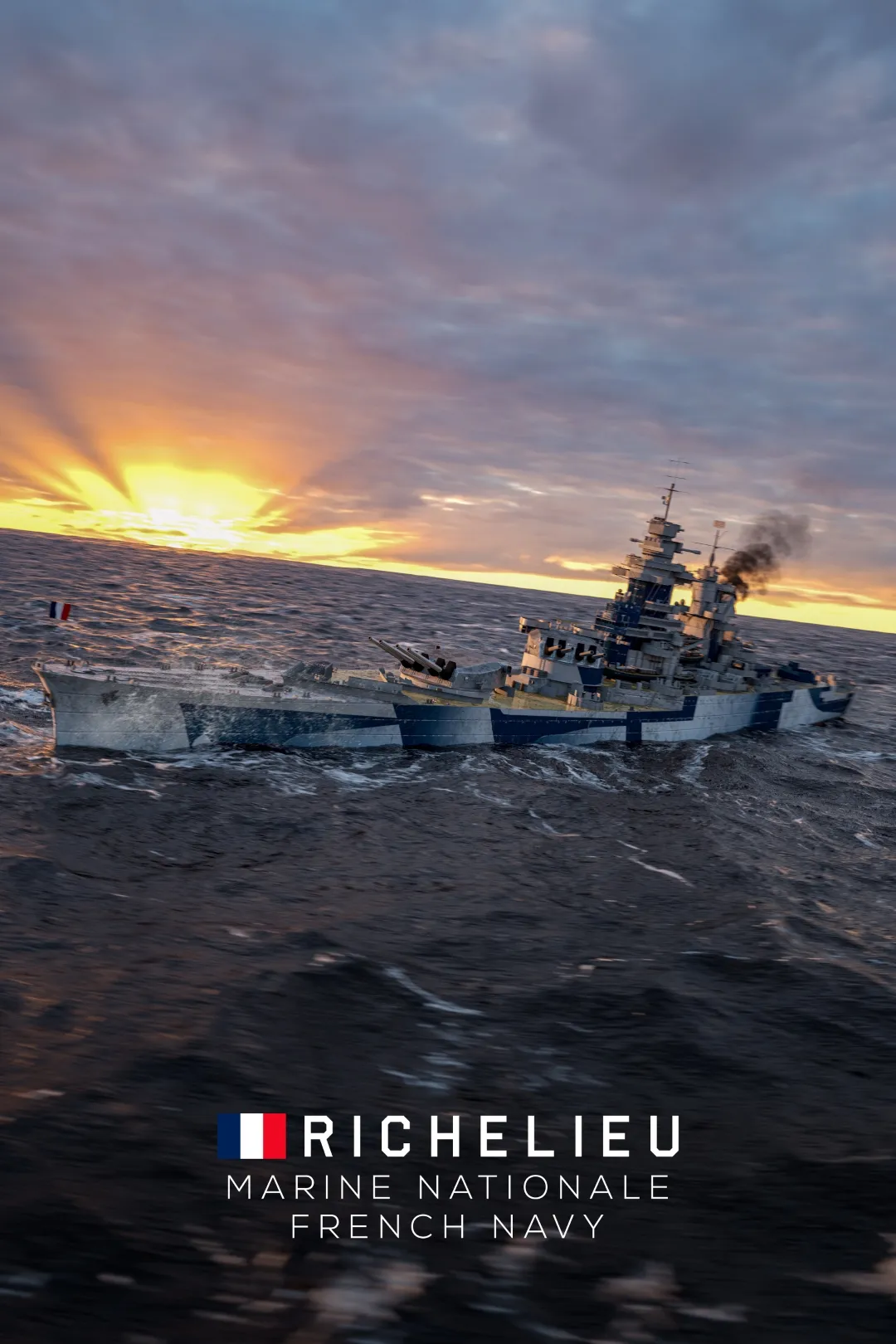
She was France's answer to a darkening world — a sleek, fast battleship whose two great quadruple turrets crowded forward like a clenched fist, leaving her stern clear and her silhouette unmistakable. Laid down in the late 1930s to counter Italy's new dreadnoughts, Richelieu was the lead ship of France's most powerful battleship class, carrying eight 380 mm (15-inch) guns concentrated forward, heavy armour, and a turn of speed that few rivals in the Mediterranean could match. She was a statement in steel: France would not be outgunned at sea. Then France fell. In June 1940, with German armies pouring south and her builders' yard at Brest under threat, Richelieu fled barely complete, steaming for Dakar in French West Africa with civilian workers still aboard. There she became a prize neither side could ignore — a modern capital ship that might tip the balance if she fell into the wrong hands. The British struck first. In July 1940 aircraft and a motor boat attacked her in harbour, and that September, during Operation Menace, her guns dueled a British and Free French force off the African coast while Vichy loyalists held her fast. It was a tragedy in miniature: a French battleship firing on her former allies, a nation at war with itself. Her exile ended in 1943. After the Allied landings in North Africa swung French forces back to the common cause, Richelieu crossed the Atlantic to New York, where American yards repaired and modernised her, crowning her with radar and a forest of anti-aircraft guns. She emerged transformed — and joined the fight at last. She served with the British Home Fleet, covering operations in northern waters, then sailed east to the Indian Ocean with the Eastern Fleet, hunting Japanese forces and pounding shore targets from Sumatra to the Andaman Islands. When Japan surrendered, Richelieu was present in the East Indies to witness the empire's collapse, her long war finally vindicated. She came home to a liberated France a heroine, having fought under two flags and survived the worst years a warship could know — bombed, torpedoed, exiled, and reborn. For more than two decades she served the postwar navy as a floating symbol of restored French pride, a reminder that the nation's fleet had endured the humiliation of 1940 and returned to the victorious side. She was finally decommissioned in 1967 and scrapped soon after, but France could not quite let her go: one of her colossal 380 mm gun barrels still stands at Brest, near the waters where her story began. Richelieu's life reads like the story of France itself in those years — proud, then broken, then divided against itself, and at last redeemed. Few warships carried so much national feeling in their hull, and fewer still lived through betrayal and exile to sail home in triumph. To reconstruct her is to recover not just a beautiful and formidable ship, but a survivor: the battleship that endured the fall of her country and refused to let it be the end of her story.
Reconstruction Pipeline
Frequently Asked About French Battleship Richelieu
What was the French battleship Richelieu?
Richelieu was a fast battleship of the Marine Nationale and lead ship of her class, armed with eight 380 mm (15-inch) guns in two unusual forward quadruple turrets. Completed during WWII, she was one of the most powerful battleships ever built in Europe.
Did Richelieu ever fight against the Allies?
Briefly. After France fell in 1940 she was based at Dakar under Vichy control and exchanged fire with British and Free French forces during the Battle of Dakar in September 1940. In 1943, after a refit in New York, she joined the Allied cause.
What happened to Richelieu after WWII?
She served the postwar French navy as a symbol of restored pride, was decommissioned in 1967 and scrapped, though one of her 380 mm gun barrels is preserved as a monument at Brest.