HNLMS Java Poster
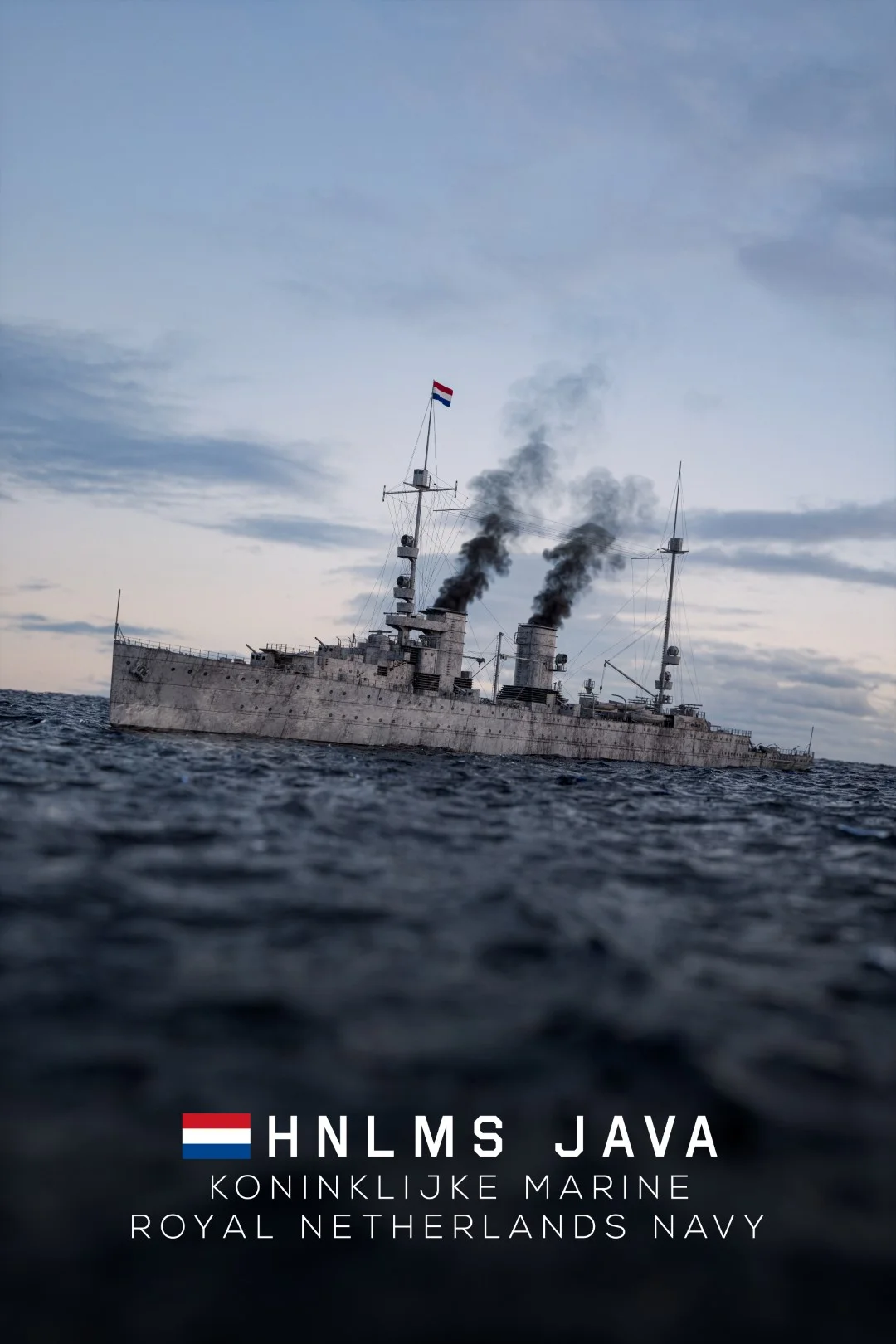
She was the guardian of a distant empire, and she died defending it against overwhelming odds. HNLMS Java was a light cruiser of the Royal Netherlands Navy, built in the years after the First World War to protect the Dutch East Indies — the vast, rich island colonies, stretching across what is now Indonesia, on which much of the Netherlands' wealth depended. Armed with ten 150 mm guns, she patrolled those warm equatorial waters for years as a visible symbol of Dutch power in the Far East. When war came roaring south in late 1941, she found herself thrust onto the front line of a hopeless fight. After Japan struck across the Pacific, the Allies scrambled to defend the East Indies with the makeshift ABDA Command — a patchwork of Dutch, British, American and Australian ships placed under Dutch leadership, united more by desperation than by training together. Their commander, the determined Rear Admiral Karel Doorman, flew his flag in the cruiser De Ruyter, with Java among his squadron. Outnumbered, outgunned, lacking air cover and worn down by constant operations, they nonetheless sailed straight into the path of the Japanese invasion fleets, with little realistic hope of victory but a fierce resolve to try to stop the landings. The end came at the Battle of the Java Sea on 27 February 1942. Through a long and confused action that ran from daylight into darkness, Doorman's fleet was steadily torn apart by accurate Japanese gunfire and by the fearsome "Long Lance" torpedoes — weapons of extraordinary range that the Allies did not know existed, striking out of the night with devastating effect. Late in the battle, in the darkness, a torpedo slammed into Java and detonated her after magazine. The explosion ripped through the cruiser, and she sank quickly into the warm black sea, taking the great majority of her crew — and, with her admiral's flagship lost the same night, the last hopes of the Allied defence — down with her. Doorman himself went down aboard De Ruyter in the same disastrous engagement. The defeat was total. With the Allied fleet shattered, the East Indies fell to the Japanese within weeks, and the survivors faced years of captivity. But the sailors of HNLMS Java had fought to the last for the islands they were sworn to protect, in a battle whose outcome was all but decided before it began. Her story has a haunting modern coda. The wreck of HNLMS Java was located on the floor of the Java Sea, a recognised war grave for the men who died aboard her — only to be found, years later, to have largely vanished, illegally salvaged for scrap metal in one of the most notorious cases of wreck plundering in recent times. The ship herself is gone from the seabed; the memory of her last fight is not. To reconstruct HNLMS Java is therefore to do something the salvagers tried to make impossible: to restore a ship that has been physically erased, and to honour a cruiser and a crew who stood and fought for a doomed colony in the Allies' darkest hour.