The Story of USS Kidd
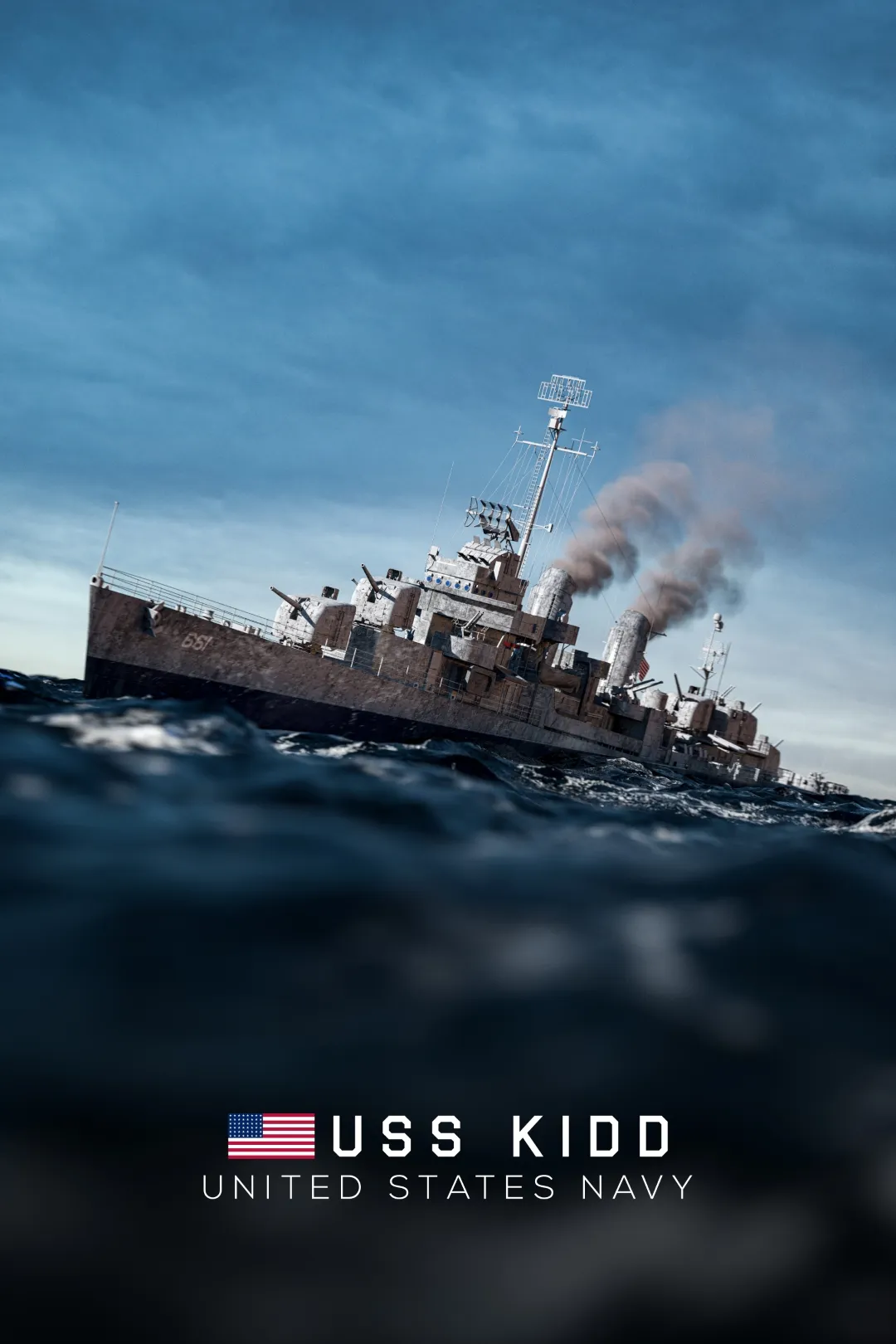
She is the only ship in the United States Navy permitted to fly the Jolly Roger — the pirate flag — and she earned that swashbuckling honour the hard way. USS Kidd was a Fletcher-class destroyer named for Rear Admiral Isaac Kidd, who was killed aboard the battleship Arizona at Pearl Harbor. By happy coincidence the name echoed that of the famous pirate Captain William Kidd, and her crew embraced the connection with relish, painting a pirate on her forward stack and flying the skull and crossbones — a tradition the Navy, unusually, allowed her to keep. Kidd fought hard through the Pacific War, screening the fast carriers, bombarding enemy-held shores, and standing guard against air attack through the bloody island campaigns of 1943 and 1944. She was a typical hard-working "tin can," doing the unglamorous, essential and dangerous work of a fleet destroyer. Her most fateful day came off Okinawa in April 1945, during the terrifying onslaught of Japanese kamikaze suicide aircraft that hurled themselves at the American fleet in their hundreds. On 11 April 1945, Kidd was serving on the radar picket line — the exposed outer ring of destroyers stationed far from the main fleet, whose vital but perilous job was to detect incoming raids early and give warning, and who therefore drew the kamikazes upon themselves. A suicide plane evaded the destroyer's furious anti-aircraft fire and slammed into her hull near the waterline. The explosion tore through the ship, killing 38 of her crew and wounding many more. But Kidd's well-drilled sailors fought the fires and flooding, saved their ship, and brought her home — battered but alive. Repaired, she returned to service and went on to serve in the Korean War as well, adding to a long and distinguished career before finally being retired. Today USS Kidd is preserved as a museum ship at Baton Rouge, Louisiana, on the Mississippi River. She is one of the best-preserved Fletcher-class destroyers in the world, kept and restored to her authentic Second World War configuration rather than later modernised fittings — so that to walk her decks is to step directly into 1945. The "Pirate of the Pacific" rests there still, her Jolly Roger a reminder of a hard-fighting ship, a hard-won spirit, and the 38 men who died defending her. To reconstruct USS Kidd is to capture that rare blend of fighting record and roguish character — the destroyer with the pirate flag, the survivor of a kamikaze strike, and one of the few of her many sisters to be preserved intact. She is both a memorial to the sailors who fought and died in her, and a vivid, tangible link to the destroyer war in the Pacific that visitors can still walk aboard today.
Reconstruction Pipeline
Frequently Asked About USS Kidd
Why can the USS Kidd fly the Jolly Roger?
Named for Admiral Isaac Kidd — and echoing the pirate Captain Kidd — her crew adopted the pirate flag. She is the only US Navy ship permitted to fly the Jolly Roger.
Where is the USS Kidd today?
Preserved as a museum ship at Baton Rouge, Louisiana — one of the best-preserved Fletcher-class destroyers, restored to her WWII configuration.
Was the USS Kidd ever hit?
Yes — a kamikaze struck her off Okinawa on 11 April 1945, killing 38 of her crew, but she survived and was repaired.