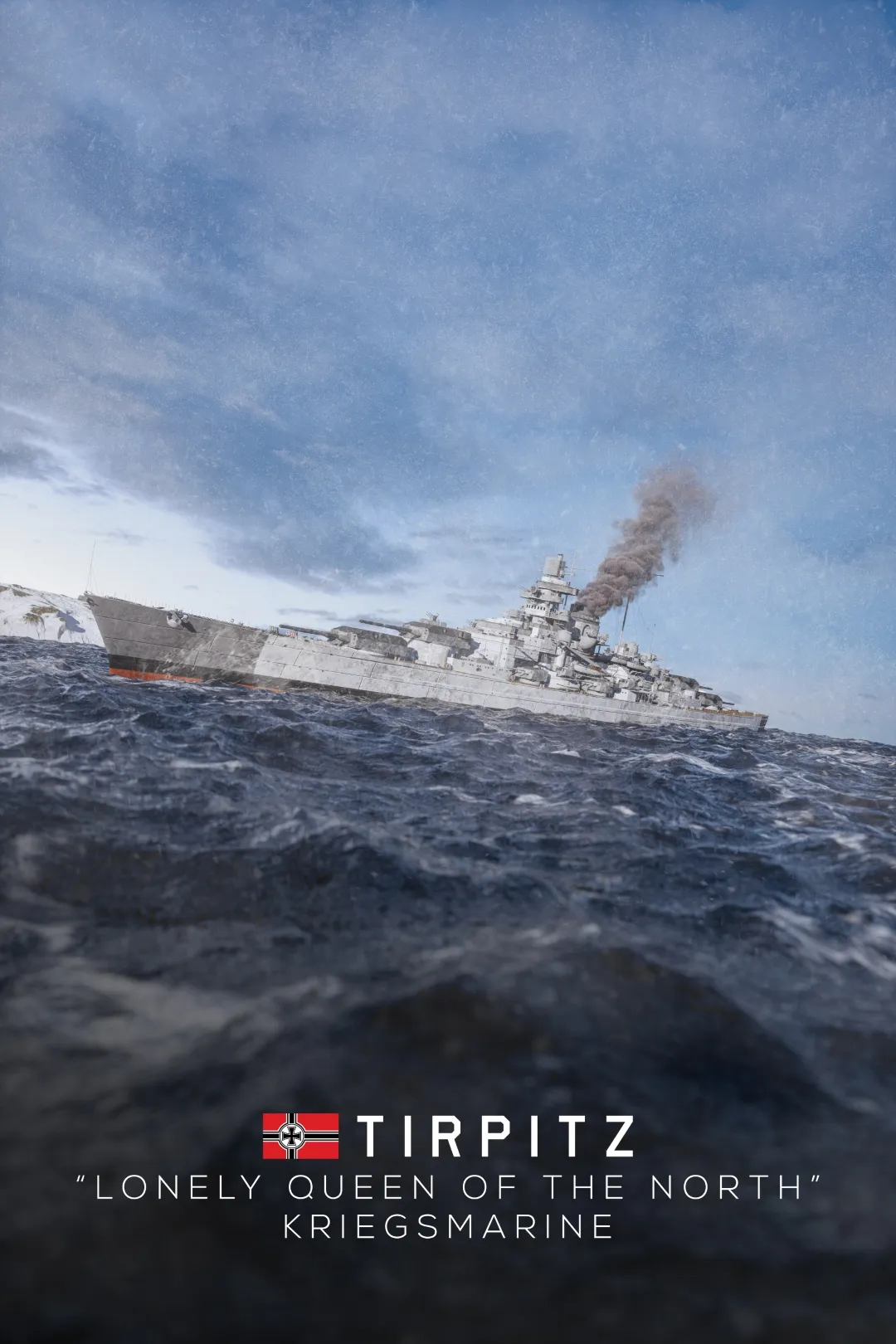
German Battleship Tirpitz Poster
She was the sister of Bismarck, slightly larger and even more powerful — and she barely fired a shot in anger her entire career. Yet Tirpitz may have been the most influential warship of the whole war, a monster that fought her greatest battles simply by existing. Winston Churchill called her "The Beast," and an entire Allied campaign was built around the single goal of her destruction. After Bismarck's death in 1941, the Germans dared not risk her twin in the open ocean. Instead they hid her in the deep, narrow Norwegian fjords, a coiled threat looming over the Arctic convoys carrying vital supplies to the Soviet Union. From those sheltered anchorages she did not need to sail to win victories. In July 1942 the mere report that Tirpitz had put to sea caused the Admiralty to order convoy PQ-17 to scatter — and U-boats and aircraft then fell upon the dispersed, defenceless merchant ships and slaughtered them. Tirpitz had won a devastating victory without firing a gun, by the sheer terror of her name. The Allies became obsessed with her. They had to be: while she existed, the Royal Navy was forced to keep powerful forces in northern waters to guard against her, ships desperately needed elsewhere. So they came for her, again and again, with a persistence bordering on fixation. In 1943 British midget submarines — tiny X-craft crewed by a handful of men — crawled through the fjords and minefields to plant charges beneath her hull, badly damaging her in a feat of almost unbelievable courage. Carrier aircraft struck her. Raid after raid was flown against her. And still she endured, repaired and lurking, tying down Allied strength month after month. The end finally came from the sky. In late 1944 the RAF brought out the colossal "Tallboy" — a six-ton armour-piercing bomb designed by Barnes Wallis, capable of smashing through almost anything. On 12 November 1944, heavy Lancaster bombers found Tirpitz at her anchorage near Tromsø, beyond the reach of her fighter cover. Two or more Tallboys struck home, tearing the great battleship open. A magazine exploded, and within minutes she capsized, rolling over and trapping hundreds of men inside her overturned hull. Over 900 of her crew died. Tirpitz never sank an enemy warship. She never had to. For three years she was a phantom in the fjords, and her shadow stretched across the entire northern war — diverting fleets, scattering convoys, and forcing her enemies to spend extraordinary effort and courage just to keep her contained. No ship better illustrates the strange power of a "fleet in being": a weapon whose greatest effect came not from what it did, but from what it might do. To reconstruct Tirpitz is to capture that menace — the silent giant in the cold blue fjord, the most dangerous ship that hardly ever fought, whose very presence shaped the war at sea. Her capsized hull was eventually broken up after the war, but her legend as "The Beast" of the north endures, the battleship that won battles by simply refusing to leave her lair.