USS Arizona Poster
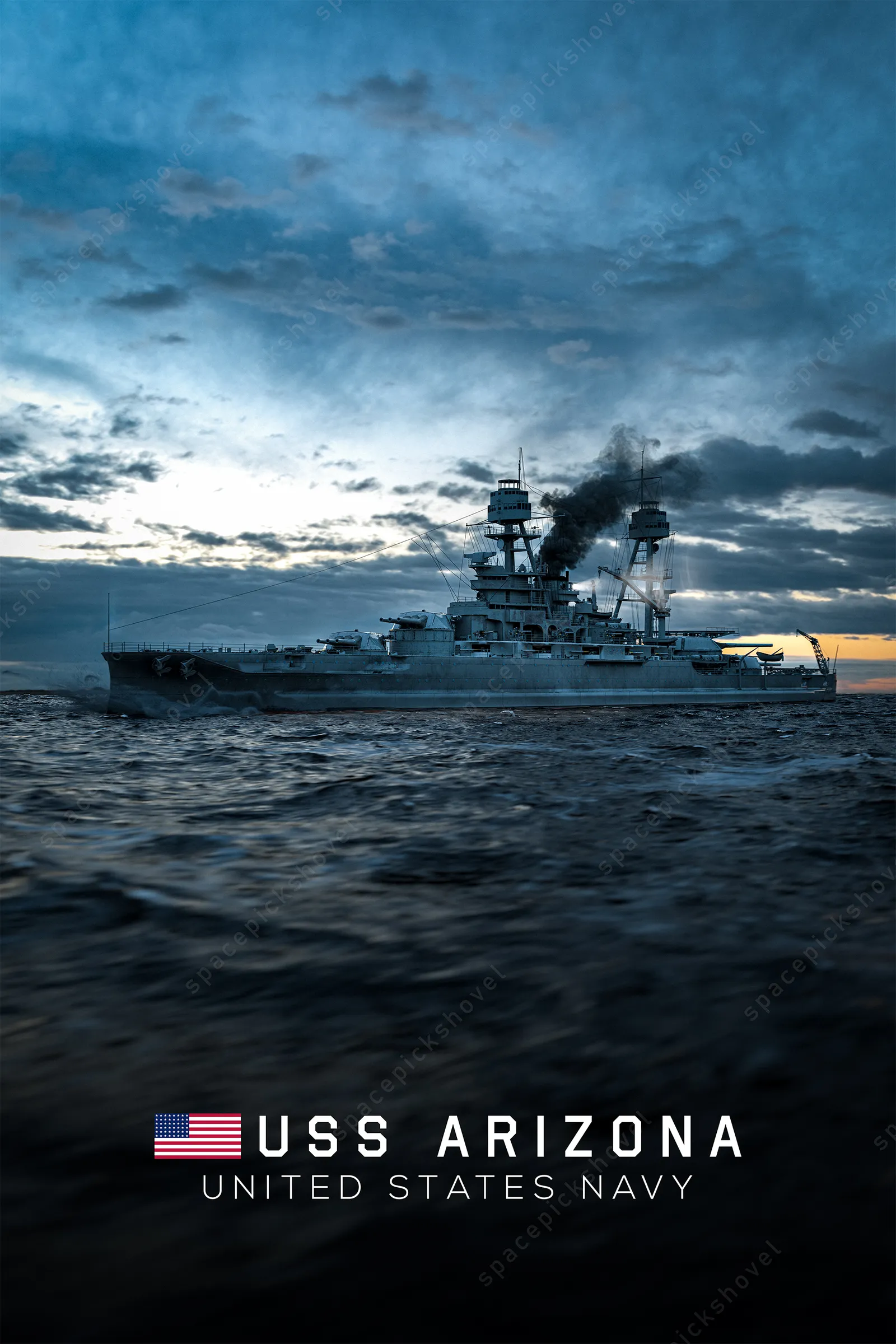
No ship in the American story is more sacred. USS Arizona was a powerful battleship of the Pennsylvania class, mounting twelve 14-inch guns, the pride of a peacetime fleet and a familiar sight to a generation of Americans. But she is remembered not for the battles she fought — she fought none of note — but for the morning she died, and for the men who lie within her still, more than eighty years on. On the quiet Sunday morning of 7 December 1941, Arizona lay moored along Battleship Row at Pearl Harbor, a calm and ordinary start to a day that would change the world. Then waves of Japanese aircraft came screaming out of the sky in a surprise attack that caught the American fleet at anchor. In the chaos and thunder of that assault, a bomb plunged down and detonated in the area of Arizona's forward magazines — the compartments where her enormous stores of gunpowder and shells were kept. The explosion was apocalyptic: a single, colossal blast that lifted the great battleship partly out of the water, tore her forward section apart, and sent a towering column of fire and black smoke hundreds of feet into the sky, an image seared into the memory of everyone who saw it. Arizona was destroyed in an instant. Of her crew, 1,177 officers and men were killed — nearly half of all the Americans who died in the entire attack on Pearl Harbor. Many were entombed inside the shattered, sinking hull, where they remain to this day. Whole groups of friends died together; among the dead were sets of brothers who had served side by side, and a father and son. It was a wound to the nation as much as to the Navy. The attack plunged the United States into the Second World War, and the cry "Remember Pearl Harbor!" — and Arizona above all others — became the rallying call of a nation roused to total war. Her name came to stand for the shock of that morning and the resolve that followed. Today the sunken hull of USS Arizona lies where she fell, in the shallow water of Pearl Harbor, beneath a gleaming white memorial that spans her without touching her. Oil still seeps slowly to the surface from her ruptured tanks, drop by drop, day after day — sailors and visitors call them the "black tears" of the Arizona, as if the ship herself still weeps for her lost crew. She has never been raised. She is a war grave, a shrine, and an eternal reminder. To reconstruct USS Arizona is to approach something close to holy ground in American memory — not a fighting record, but a place of loss and remembrance. She is the ship whose destruction began America's war and whose entombed crew are honoured still, the battleship that became a monument to a single terrible morning and to the more than eleven hundred men who never left her.