Italian Battleship Vittorio Veneto Poster
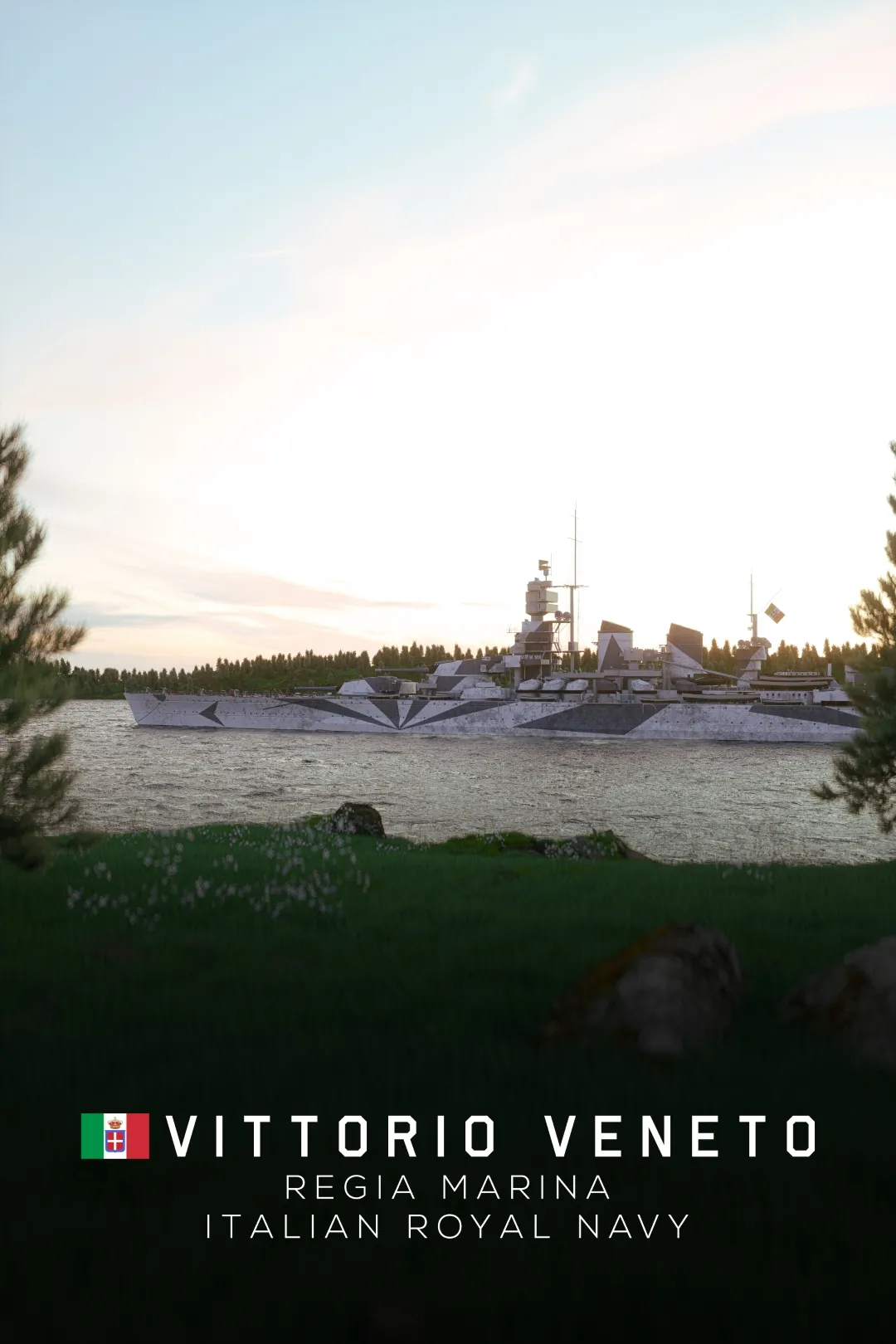
She was the workhorse of Italy's battle fleet — the most active of the great Littorio-class battleships, and the one that came closest, again and again, to changing the balance of power in the Mediterranean. Vittorio Veneto carried nine 381 mm (15-inch) guns and the speed to use them, and the Royal Navy treated her as one of the most dangerous ships in the sea, a constant factor in every calculation about the central Mediterranean. She fought hard from early in the war, sortieing to challenge the British convoys and clashing repeatedly with the Royal Navy in a series of fierce actions. Her most dramatic moment came at the Battle of Cape Matapan in March 1941. There, Vittorio Veneto fought a running gun duel with British cruisers, then was struck by a torpedo from a British carrier aircraft that flooded her stern and slowed her badly. For a time it seemed the British battle fleet might catch and destroy her — but through skilled damage control and hard, determined steaming, she limped clear and escaped into the night. The disaster fell instead on the Italian heavy cruisers Zara, Fiume and Pola, sent back to cover her, which were ambushed and annihilated in the dark by British battleships. Vittorio Veneto survived; her consorts paid the price. She fought on through the brutal convoy battles for Malta, dueling the British in the contested waters of the central Mediterranean, surviving torpedo hits from both submarines and aircraft over the course of the war. She was a tough, resilient ship that absorbed punishment and kept fighting, and her mere presence forced the British to escort every important convoy with heavy units, shaping the whole pattern of the naval war in those waters. Where her sisters' careers were defined by single catastrophes, Vittorio Veneto's was defined by endurance — always in action, always a threat, always coming back. When Italy surrendered in September 1943, Vittorio Veneto sailed to give herself up to the Allies, and survived the German glide-bomb attack that destroyed her sister Roma on the same fateful voyage — passing through the disaster that claimed the flagship and living on. She spent the rest of the war interned under Allied control in the Suez Canal area, her fighting days behind her, and was eventually handed to Britain as a war prize and scrapped in the early 1950s. A fighter to the end of her active life, she was the battered, durable champion of Italy's wartime navy — the battleship that did the most, fought the most, and survived the most, even as misfortune and a losing war denied her a decisive victory. To reconstruct Italian battleship Vittorio Veneto is to capture the hardest-working capital ship of the Regia Marina — fast, powerful and resilient — at the centre of the long Mediterranean struggle. She escaped the trap at Matapan, weathered torpedoes and bombs, outlived the loss of her sister, and came through the war when so many did not, a proud survivor of a navy that fought a difficult war against long odds.