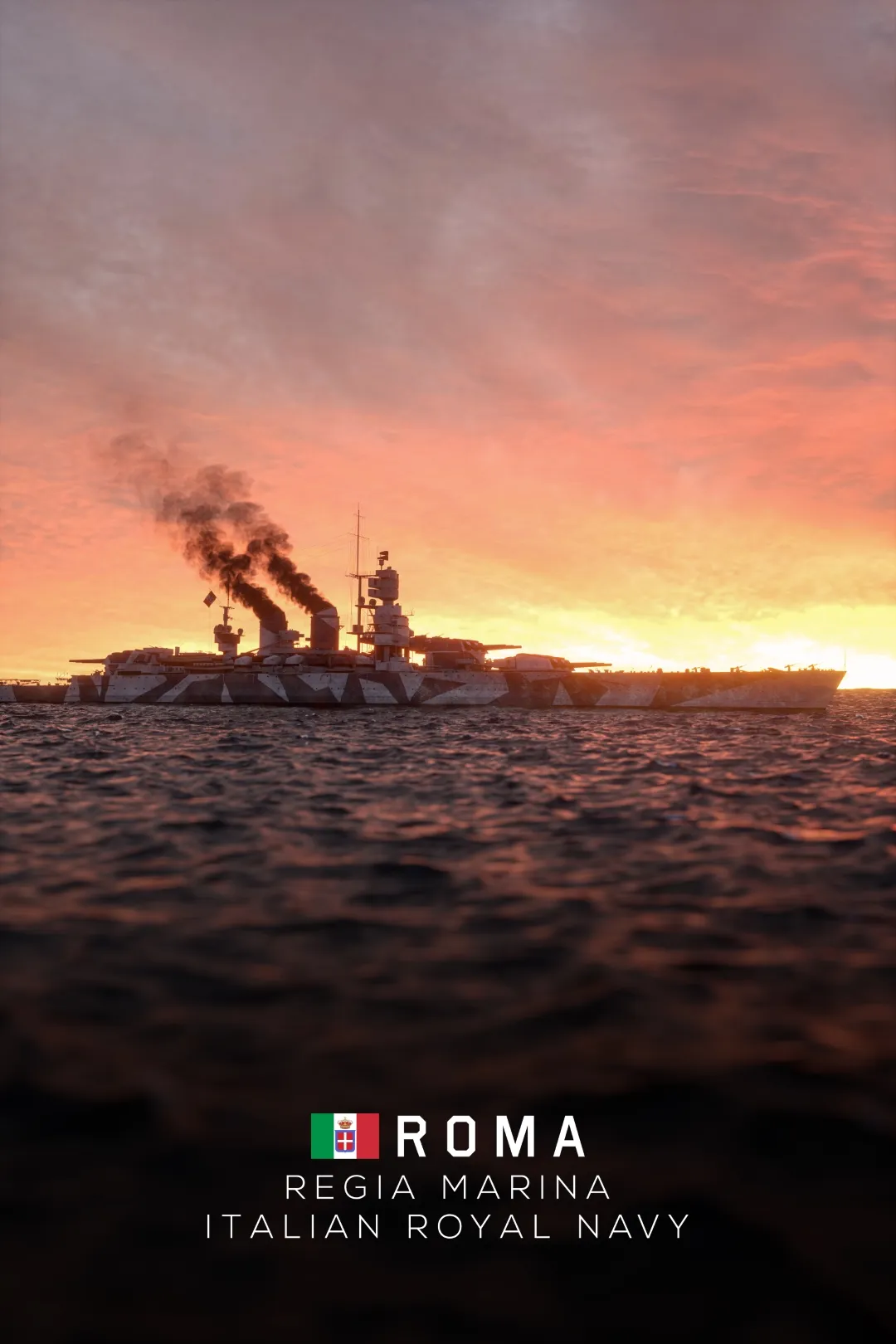
Italian Battleship Roma Poster
Her story is one of the most haunting in naval history — a magnificent battleship destroyed not by an enemy, but by the allies she had just abandoned, killed by a weapon that pointed toward the future of war itself. Roma was one of Italy's superb Littorio-class battleships, fast and powerful, mounting nine 381 mm (15-inch) guns, and she served as flagship of the Italian battle fleet. She was among the finest warships Italy ever produced. For much of her short career Roma was held back. Italy's fuel shortages and the steady erosion of its naval position meant that the battle fleet spent long stretches in harbour, and Roma — a precious, prestigious asset — saw relatively little real combat, riding out air raids in her northern bases. Her defining moment, when it came, was not a battle at all, but a surrender. In September 1943 Italy capitulated and changed sides, joining the Allied cause. To keep their powerful fleet out of German hands, the Italians ordered their warships to sail to Allied ports and give themselves up. On 9 September 1943, Roma led the Italian battle fleet out of harbour and steamed toward Malta to surrender. The Germans, enraged at what they saw as a betrayal, struck back from the air with a terrifying new weapon: the Fritz X, a radio-guided armour-piercing glide bomb — one of the world's first true precision-guided munitions, released from high-flying bombers and steered onto its target from above. The German bombs found Roma. One struck the great battleship and punched deep into her hull. Then a second Fritz X hit home, and this one detonated a forward magazine. The explosion was catastrophic: it tore the ship open and blew one of her main turrets clean into the sea. Roma broke in two and sank within minutes, taking with her more than 1,300 men, including the fleet commander, Admiral Carlo Bergamini. In a few moments, one of the most powerful warships in the Mediterranean was gone — destroyed in the very act of trying to leave the war. It was a stunning demonstration of the guided weapons that would reshape warfare in the decades to come, and a profound tragedy for a ship and crew killed while sailing toward peace, by the allies they had only just deserted. The story carried a weight of bitter irony that has never faded: the battleship undone not by the enemy she was built to fight, but by her former partner's newest invention. Roma's wreck was discovered on the seabed off Sardinia in 2012, lying broken in two main pieces far below — a quiet grave for a battleship caught between two sides at the moment her country changed allegiance. To reconstruct Italian battleship Roma is to capture both a beautiful capital ship and one of the war's most poignant moments: the flagship blown apart by a glimpse of the future of warfare, sunk on the road to surrender. Hers is a portrait of grandeur and tragedy entwined — the proud ship that died reaching for peace.