Italian Battleship Littorio Poster
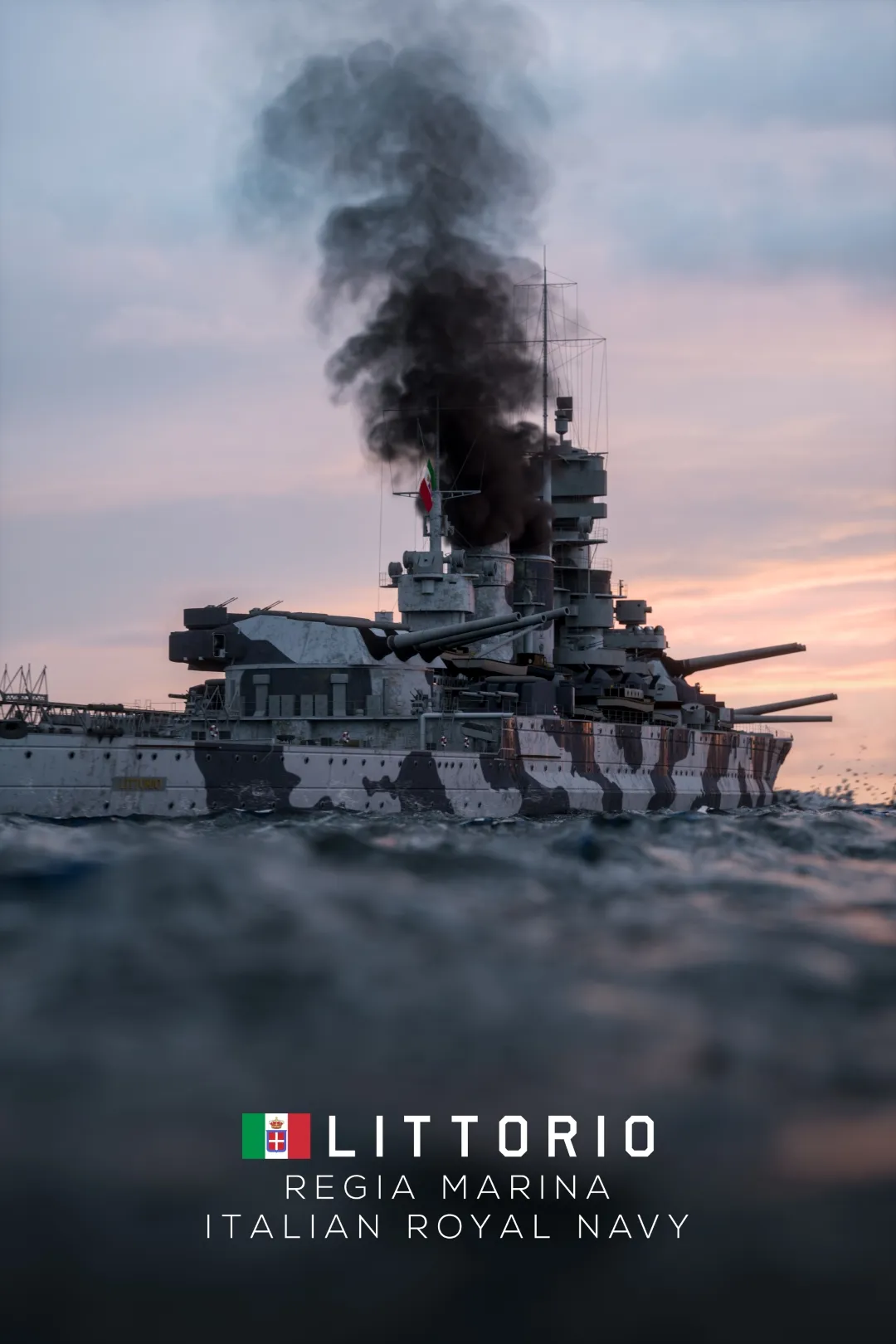
She was the namesake of Italy's finest battleships, a fast and modern dreadnought bristling with nine 381 mm (15-inch) guns — a powerful symbol of Mussolini's ambition to make the Mediterranean an Italian sea, mare nostrum. Sleek, heavily armed and well protected, Littorio was a genuine threat to British naval supremacy in those crowded waters. But her career would be marked as much by misfortune as by power, and it began with one of the most famous humiliations in naval history. In November 1940, while moored in the supposedly safe harbour of Taranto, Littorio was caught by one of the most daring raids ever flown. British Swordfish torpedo bombers, launched at night from the carrier HMS Illustrious, swept in over the anchored Italian battle fleet. Three torpedoes struck Littorio, and the brand-new battleship settled to the harbour bottom amid the chaos. The Taranto raid crippled Italy's battle fleet in a single night, swung the balance of the Mediterranean toward Britain, and demonstrated to the whole world — the watching Japanese very much included — what carrier aircraft could do to battleships lying in harbour. It was a preview of Pearl Harbor. Raised, repaired and returned to service, Littorio went back into the fight. She fought in the running battles to interdict the vital British convoys to the besieged island of Malta, including the fierce Second Battle of Sirte in 1942, where she dueled British cruisers and destroyers in heavy seas. For the rest of her active career she was a constant menace, a powerful unit that forced the Royal Navy to commit major forces to protect every convoy that ran the gauntlet of the central Mediterranean. Then the war turned, and with it her allegiance. In 1943 Mussolini fell and Italy switched sides. Renamed Italia after the dictator's downfall, the battleship sailed to surrender to the Allies — and on that very voyage she was attacked by her former German allies, who struck the departing Italian fleet with radio-guided Fritz X glide bombs. Italia was hit and damaged but survived, even as her sister Roma, struck by the same terrible new weapon, blew up and sank with most of her crew. It was a final, bitter irony: the ship that had begun the war menacing the British ended it under fire from the Germans, while fleeing to join the Allies. She spent the rest of the war interned in Allied hands, her fighting days over, and was eventually handed across as a war prize and broken up in the years that followed. A powerful, modern and beautiful ship, she had been undone again and again by the misfortunes of a war Italy could not master — sunk at her moorings at Taranto, then nearly destroyed by her own allies while changing sides. To reconstruct Italian battleship Littorio is to capture one of the most striking capital ships of the Mediterranean war — the pride of Mussolini's navy — and with her the whole arc of Italy's naval struggle: ambition, the disaster at Taranto, the long convoy battles, and the strange, divided end. She was a magnificent ship caught in an impossible war, and her story is among the most dramatic of any battleship afloat.