IJN Shokaku Poster
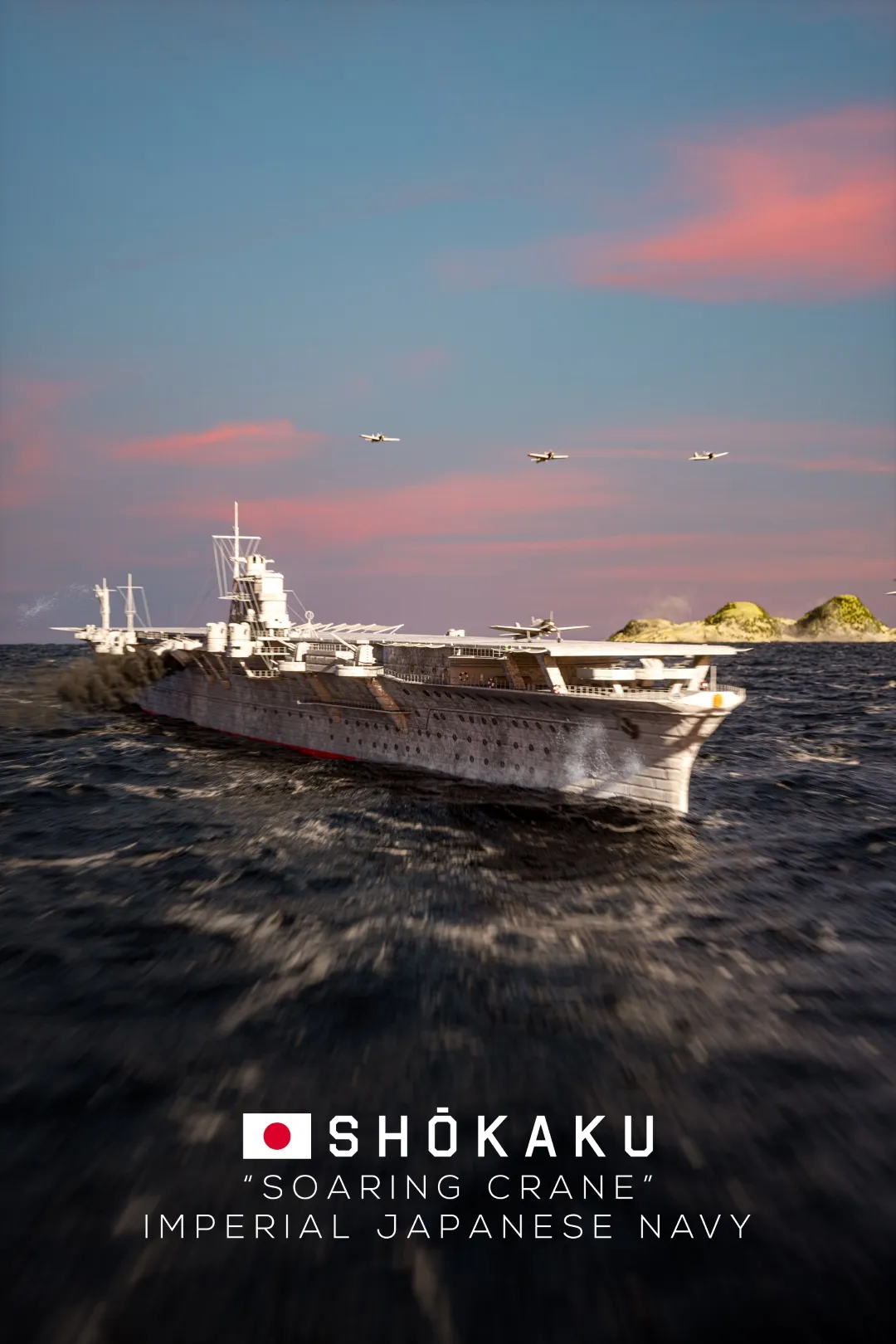
She was arguably the finest aircraft carrier Japan ever built, and she fought in nearly every great carrier battle of the Pacific War. IJN Shokaku — "Soaring Crane" — combined speed, a large and well-trained air group, good protection and a superb, balanced design, and together with her sister Zuikaku she formed Carrier Division 5, a deadly pair that arrived just in time to help launch the war and went on to become the backbone of Japan's carrier strength. Shokaku's aircraft struck Pearl Harbor in December 1941, and from there she was thrown into action again and again with scarcely a pause. At the Battle of the Coral Sea in May 1942 — the first carrier-versus-carrier battle in history, fought entirely by aircraft while the opposing fleets never even sighted one another — her aviators helped sink the big American carrier Lexington, but Shokaku herself was hit by bombs and badly damaged, knocked out of action just long enough to miss the disaster at Midway a month later. That wound, painful at the time, almost certainly saved her from the fate that consumed four of her fleet-mates. Repaired, she was back for the brutal carrier slugging matches around Guadalcanal — the Eastern Solomons and the Santa Cruz Islands — where she gave and took heavy blows in the desperate struggle for the South Pacific. Time and again she was hit, sent home to be repaired, and returned to the fire, a survivor where so many carriers were lost in a single afternoon. For more than two years she was at the heart of the carrier war, one of the most battle-tested flattops in any navy. Her luck finally ran out at the Battle of the Philippine Sea in June 1944, Japan's last great carrier sortie. As her aircraft flew off to attack — and were slaughtered in the lopsided air battle the Americans called the "Great Marianas Turkey Shoot" — the American submarine USS Cavalla stalked Shokaku beneath the waves and fired a spread of torpedoes into her hull. The strikes ignited fuel vapours building inside the ship, and a catastrophic series of explosions tore the great carrier apart. She sank with well over a thousand of her crew. From the first morning of the war at Pearl Harbor to nearly the last carrier battle in the Marianas, Shokaku had soared through them all — Coral Sea, the Solomons, Santa Cruz, the Philippine Sea — taking damage and dealing it, a constant, formidable presence in the Pacific war at sea. In the end she was undone not by enemy aircraft but by a torpedo from the deep, the hidden enemy that claimed so many great ships. To reconstruct IJN Shokaku is to capture the Soaring Crane at her height — a beautifully designed, hard-fighting carrier that was present at almost every decisive moment of the carrier war and survived far longer than most. She was, by many measures, the best of Japan's carriers, and her long career and sudden, violent end together tell the story of the whole Pacific struggle in the air and on the sea.