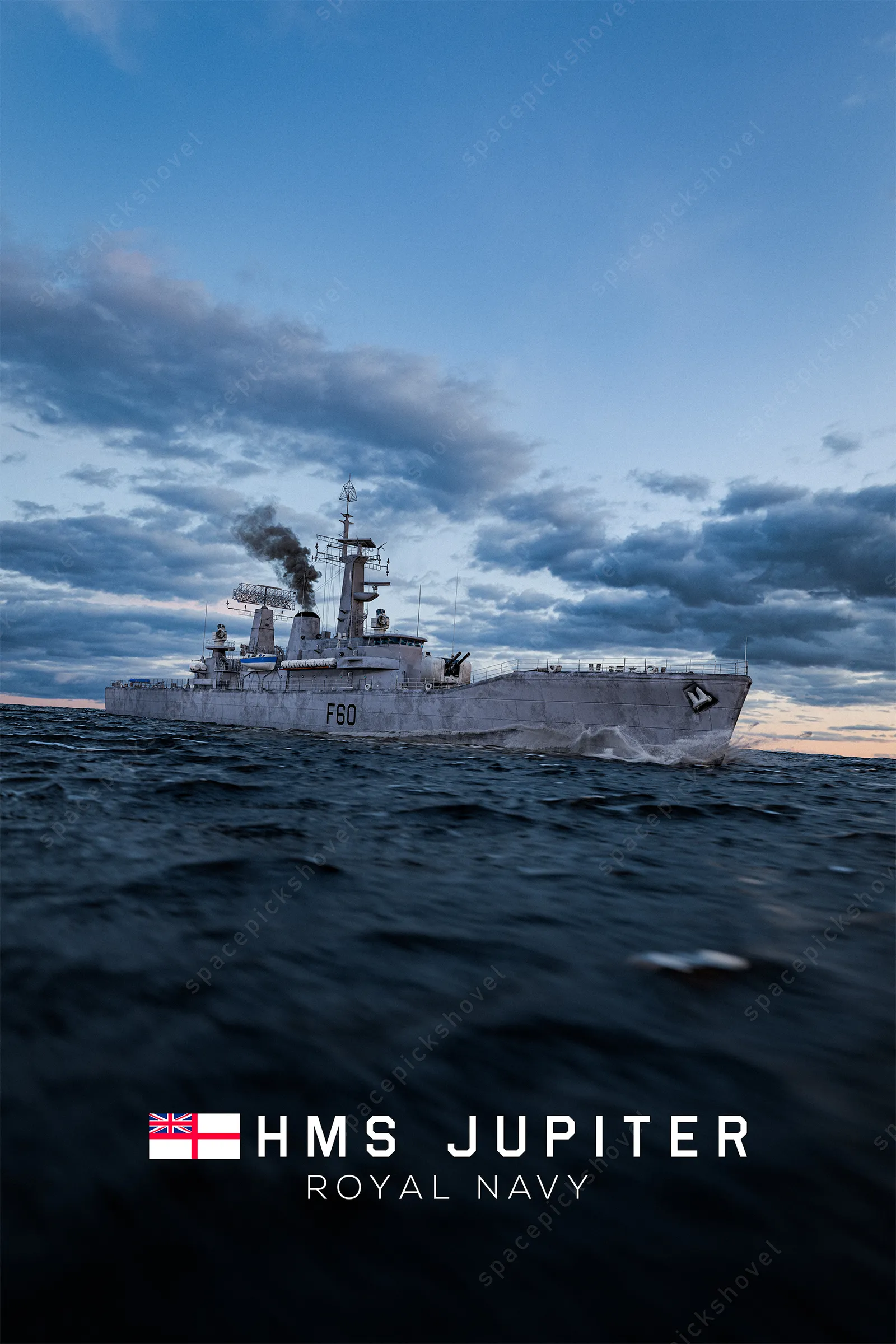
HMS Jupiter Poster
She fought her last battle far from home, in warm tropical seas, against impossible odds — and went down doing her duty in one of the most desperate and disastrous naval defeats of the entire war. HMS Jupiter was a J-class destroyer of the Royal Navy, modern, fast and well-armed with 4.7-inch guns and torpedoes, and she found her place in history not in the familiar waters of the North Atlantic but in the doomed defence of the Dutch East Indies in the opening months of 1942. After Pearl Harbor, the Japanese swept south with terrifying speed, overrunning Malaya, the Philippines and the rich island colonies of the Dutch East Indies almost faster than the Allies could react. To stop them, a scratch force of American, British, Dutch and Australian warships — the ABDA fleet — was thrown hastily together under Dutch command. It was a force outnumbered, outgunned, exhausted by constant operations, short of fuel, ammunition, air cover and even a common language between its ships, sailing into the path of a confident and superbly trained enemy. HMS Jupiter was part of it. On 27 February 1942 came the Battle of the Java Sea, a long, grinding action that stretched from afternoon into night as Rear Admiral Karel Doorman's Allied squadron tried again and again to reach the Japanese invasion convoys and was repeatedly blocked by their covering force of cruisers and destroyers. The battle went badly almost from the start. Allied ships were picked off one by one by accurate Japanese gunfire and by the dreaded "Long Lance" torpedoes — weapons of astonishing range and power that the Allies did not even know existed, and which struck like bolts from nowhere out of the darkness. Late that night, as the battered, dwindling fleet manoeuvred in the blackness still searching for the enemy convoys, Jupiter was suddenly rocked by a violent explosion and began to sink. The bitter irony was that she had not been hit by the Japanese at all: she had run onto a mine — one laid earlier, it is believed, by a friendly Dutch ship in those same contested waters. Her crew abandoned the dying destroyer into the warm, black sea. Many survived the sinking only to be captured, and to endure the long horror of Japanese prison camps, from which not all would return. The Battle of the Java Sea was a catastrophe for the Allies. Doorman himself died that night, his flagship and much of his fleet destroyed, and the East Indies fell within days. Yet the sacrifice was not entirely empty: ships like Jupiter had thrown themselves into a hopeless fight, sold themselves dearly, and bought a little time in the long, grim retreat. Theirs was the stubborn, doomed courage that defined the Royal Navy's darkest year. To reconstruct HMS Jupiter is to remember a fine ship and her crew caught in that desperate hour — a modern destroyer that fought to the last in a battle no one could win, far from home, in the warm dark waters of the Java Sea, and who deserves to be remembered for the fight she made rather than only the defeat she shared.