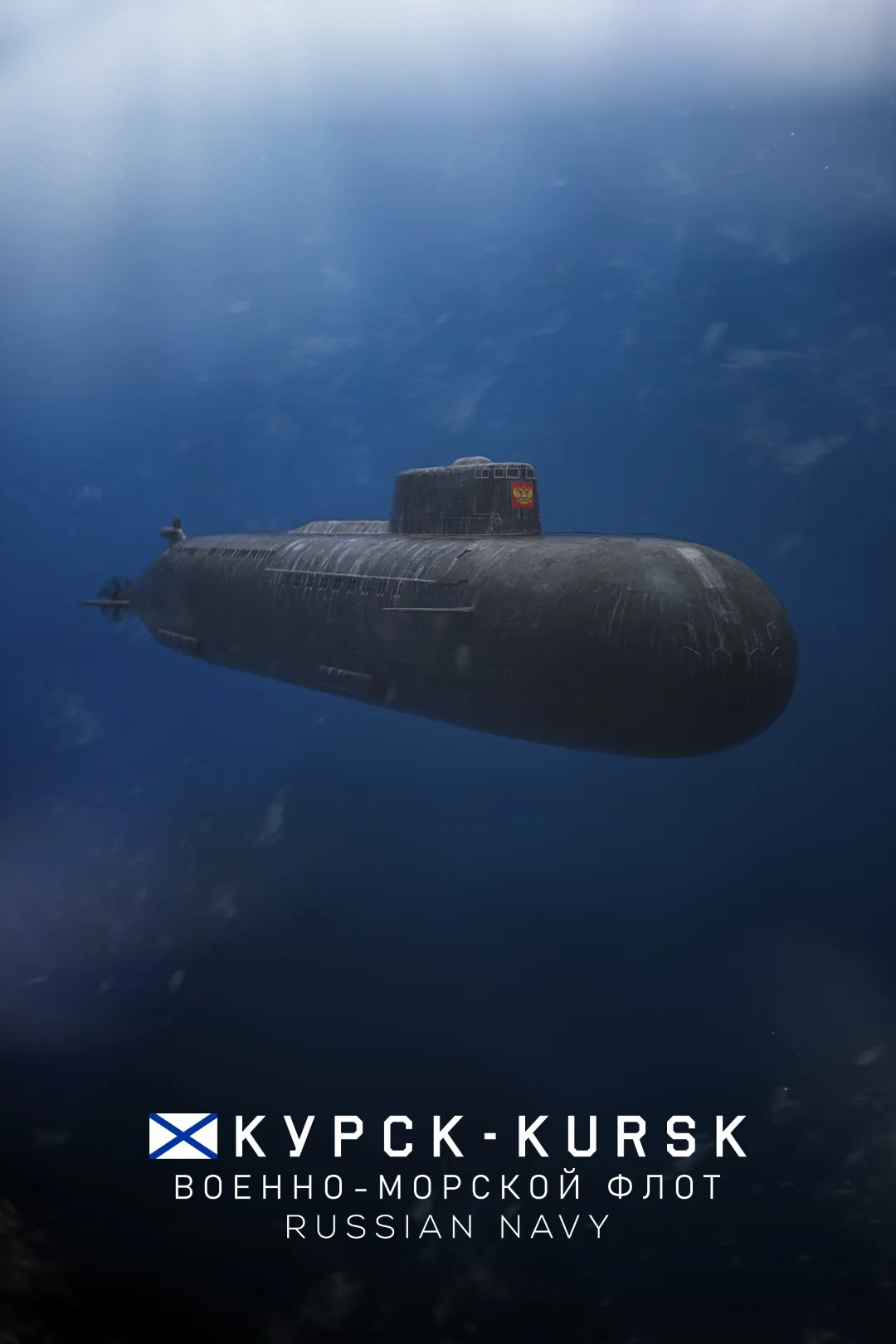
Russian Submarine Kursk Poster
She was a giant of the deep — one of the largest attack submarines ever built, a Cold War leviathan of the Russian Northern Fleet, longer than two jumbo jets laid end to end and crewed by 118 men. The Kursk was an Oscar II-class nuclear-powered submarine, designed to hunt aircraft carrier battle groups with a battery of huge cruise missiles, and she was a source of genuine national pride — considered one of the most modern, capable and survivable boats in the Russian navy. Her loss in the summer of 2000 became one of the most heartbreaking maritime tragedies of the modern age. On 12 August 2000, the Kursk was taking part in a major naval exercise in the Barents Sea, the kind of show of strength meant to demonstrate that the Russian fleet still mattered in the years after the Soviet collapse. Deep beneath the surface, disaster struck. A faulty practice torpedo leaked its volatile propellant, triggering an explosion in the forward torpedo room. Just over two minutes later, that fire detonated the warheads of several more torpedoes in a second, far larger blast — an explosion so powerful it was registered by seismographs hundreds of miles away and detected by ships and listening stations across the region. The bow of the great submarine was torn apart, and she plunged to the seabed of the shallow Barents Sea. Most of the crew died in the two explosions. But in the rear compartments, sealed off from the destruction, 23 men survived the initial catastrophe. Trapped in the cold and darkness on the bottom of the sea, with the air slowly failing, they waited for a rescue that they must have prayed would come in time. One officer, Lieutenant-Captain Dmitri Kolesnikov, wrote notes to his wife and a record of who was still alive, words later recovered from his body that gave the world a glimpse of those final hours. But the rescue did not come in time. Confused and delayed efforts, damaged equipment, and a reluctance to accept offers of foreign help meant that by the time divers finally reached the wreck, all aboard were dead. The Kursk disaster stunned Russia and the world. It became a symbol of a navy in decline and of a national grief that ran very deep, compounded by anger at the slowness and secrecy of the response. In an extraordinary salvage operation the following year, much of the great submarine was raised from the seabed and her crew recovered for proper burial, a final act of recovery for the families left behind. Her 118 men are remembered still — sailors lost not in war but in peacetime, in the silent, freezing depths, in a tragedy that touched people far beyond Russia's borders. To reconstruct the submarine Kursk is to remember a modern leviathan and the men who died inside her — a Cold War giant lost in a catastrophe of peacetime, and a story of courage, grief and the unforgiving nature of the sea that still resonates a quarter of a century on. Hers is the one tale in this fleet that belongs not to a distant war, but to living memory.